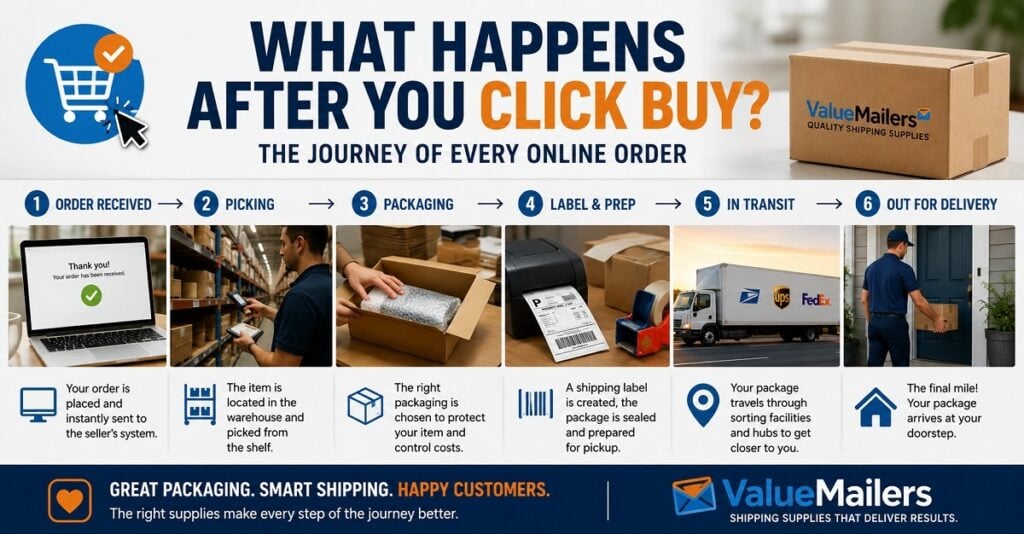
You click Buy Now, and eCommerce order fulfillment starts almost immediately.
A few seconds later, an order confirmation lands in your inbox.
But what happens next?
eCommerce order fulfillment begins the moment that order reaches the seller. From there, inventory systems, warehouse teams, packaging supplies, shipping labels, and carrier networks all work together to move one package from a shelf to your doorstep.
Most shoppers only see the checkout page and the delivery scan. However, every online order takes a much longer trip behind the scenes.
Step 1: eCommerce Order Fulfillment Starts When The Order Arrives
The journey starts when the seller receives the order.
That order may come from Amazon, eBay, Etsy, Shopify, WooCommerce, Walmart, or another online marketplace. Next, the store sends the order details into the seller’s order system or warehouse software.
Those details usually include the item purchased, quantity, buyer name, shipping address, shipping method, payment status, and any order notes.
For busy sellers, this first step matters a lot. A clean order helps the warehouse pick, pack, and ship faster. On the other hand, a bad address or incorrect item variation can slow the whole process down.
Step 2: eCommerce Order Fulfillment Teams Find The Product
After the order arrives, someone has to find the product.
This step is called picking. In a small business, a worker may simply walk to a shelf and pull the item by hand. In a larger warehouse, pickers often use scanners, aisle numbers, shelf labels, and bin locations.
Inventory systems make this work possible. They track how many units are available and where each product sits in the warehouse.
For example, a product might be stored in aisle B, shelf 4, bin 12. Because the system knows that location, the picker can move quickly and avoid grabbing the wrong item.
Accurate picking keeps eCommerce order fulfillment moving. If inventory counts are wrong, the seller may need to delay, substitute, or cancel the order.
Step 3: Packaging Choices In eCommerce Order Fulfillment
Once the item reaches the packing area, the seller has to choose the right package.
The goal is simple: protect the item without wasting space or money.
Too little protection can lead to damage. However, too much packaging can increase the package size, weight, and shipping cost.
Common shipping supplies include:
Bubble Mailers for lightweight items that need cushioning, such as accessories, small electronics, books, and cosmetics.
Corrugated Boxes for heavier, fragile, or multi-item shipments that need structure and crush resistance.
Bookfold Mailers for books, photos, documents, albums, and flat items that need corner and edge protection.
Poly Mailers for soft goods like clothing, fabric items, and non-fragile products that benefit from lightweight, moisture-resistant packaging.
Good packaging supports better eCommerce order fulfillment because it protects the product, controls postage costs, and helps the order arrive in better condition.
Step 4: Packing And Labels In eCommerce Order Fulfillment
Next, the order moves to a packing station.
The packer places the item into the selected mailer, box, or envelope. Then they may add cushioning, inserts, packing slips, or extra protection based on the product.
After that, the shipping label is created.
Many sellers use thermal labels because they print quickly, scan cleanly, and do not require ink. Before the label goes on the package, many systems also check the address format.
This check helps reduce returned packages and delivery problems. Then the seller or shipping software chooses a carrier, such as USPS, UPS, or FedEx.
The best carrier may depend on package weight, package size, destination, cost, and delivery speed.
Step 5: The Carrier Takes Over
After pickup or drop-off, the shipping carrier takes control.
The package may move from a local facility to a regional hub. Then it may travel to another sorting center closer to the customer.
Along the way, machines scan the label and route the package by ZIP code, region, and service level. Packages may travel by truck, plane, or a combination of both.
This is why tracking pages often show several scans in different cities. Each scan marks another step in the package’s path through the carrier network.
At this stage, the seller has less control. Still, strong eCommerce order fulfillment before carrier pickup helps reduce mistakes later.
Step 6: The Last Mile
The last mile is the final stage of delivery.
This is when the package moves from the local carrier facility to the customer’s home, office, mailbox, locker, or pickup point.
Several things can affect this final step. Weather, traffic, apartment access, route changes, holidays, and package volume can all change the delivery timeline.
Delivery scans help customers follow the package. A scan may say ?out for delivery,? ?delivered,? ?available for pickup,? or ?delivery attempted.?
For shoppers, the last mile is the most visible part of the journey. For sellers, it is often the hardest part to control.
What Can Go Wrong?
Even a strong shipping process can run into problems.
Incorrect addresses can send packages to the wrong place or cause returns.
Weak or damaged packaging can expose products to moisture, crushing, bending, or breakage.
Inventory errors can lead to missing items, delayed orders, or substitutions.
Weather delays can slow trucks, flights, sorting centers, and final delivery routes.
Because many people and systems touch each order, small errors can grow quickly. That is why reliable eCommerce order fulfillment depends on accurate inventory, careful packing, and clear tracking.
Why Packaging Matters More Than Most People Realize
Packaging does more than hold a product.
It protects the order, controls shipping costs, and shapes the customer’s experience.
The right package can reduce damage by giving the product the correct level of cushioning and structure. It can also lower costs by avoiding oversized boxes or unnecessary weight.
In addition, clean and secure packaging helps the order look professional when it arrives. That matters because the package is often the customer’s first physical impression of the seller.
For online businesses, packaging is part of the brand experience. A well-packed order tells the customer that the seller cared about getting it right.
Conclusion
Every package has a story.
From the moment a customer clicks Buy Now to the moment the package arrives, dozens of systems and people work together to make online shopping possible.
The better the packaging and fulfillment process, the better the customer experience.
Explore ValueMailers’ complete line of shipping supplies designed to help businesses ship smarter.