A shipping box has two costs: the price you pay for the carton and the shipping charge its size helps create. For an inexpensive product, the total cost of packaging and delivery can exceed the cost of the goods.
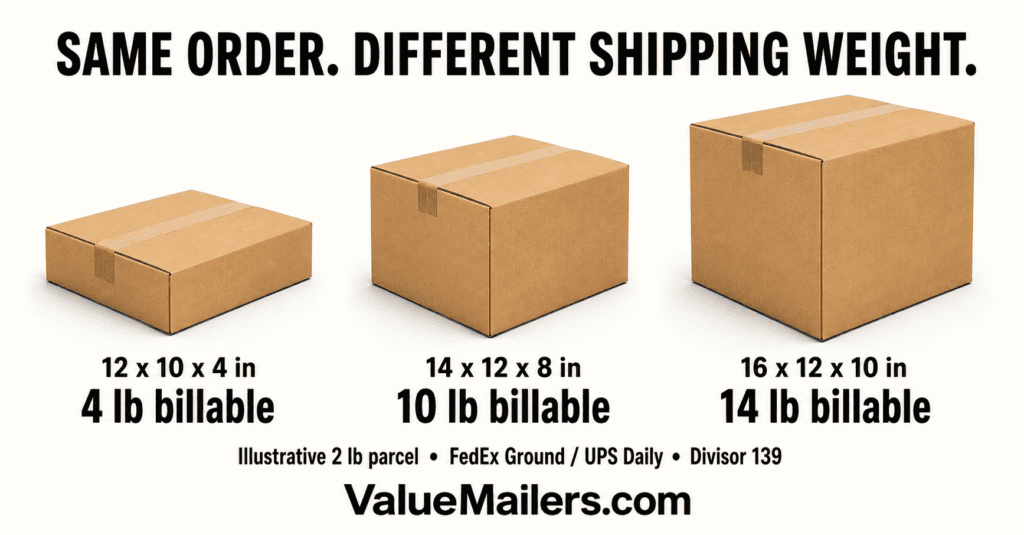
Shipping box costs extend beyond the carton itself. Dimensional weight explains why: a lightweight order in a large box can be charged at a much higher weight than the scale shows. In the example below, a hypothetical 2 lb shipment rates at 14 lb in one box and 4 lb in another under standard FedEx Ground and UPS Daily pricing rules.
That does not mean the postage falls by the same percentage. It means box selection deserves a place in your cost calculation before you buy the label.
What is dimensional weight?
Actual weight is what the completed parcel weighs on a scale. Dimensional weight is a calculated weight based on the space it occupies.
For services that apply dimensional pricing, the carrier compares the two and uses the greater rated weight, subject to its service rules. The basic calculation is:
Length × width × height in inches ÷ the applicable divisor = dimensional weight in pounds.
Apply the carrier’s dimension-rounding rules before multiplying, then round the dimensional-weight result up as required. The divisor and eligibility rules depend on the carrier, rate type, and agreement. UPS explains these measurement and calculation steps.
Measure the outside of the finished, sealed package. A box’s advertised interior size helps you check product fit; it does not establish the parcel dimensions used for shipping.
For background on choosing between mailers and boxes, see our dimensional-weight packaging guide. Here, we focus on the numbers and a practical comparison you can repeat.
Shipping box costs: the same order in three boxes
Imagine a soft apparel order that could fit safely in a shallow carton. To isolate the effect of size, this calculation assumes a final packed weight of exactly 2 lb for every option. In a real test, weigh each completed package separately.
These are hypothetical measured exterior dimensions, not ValueMailers product specifications, shipping quotes, or results from a physical test.
| Measured exterior box size | Volume | FedEx Ground / UPS Daily | USPS Ground Advantage Commercial* |
|---|---|---|---|
| 12 × 10 × 4 in | 480 in³ | 4 lb | 2 lb |
| 14 × 12 × 8 in | 1,344 in³ | 10 lb | 2 lb |
| 16 × 12 × 10 in | 1,920 in³ | 14 lb | 14 lb |
The USPS column shows ordinary weight-based pricing, not Ground Advantage Cubic. The comparison excludes special contracts, flat-rate products, and separate fees.
For the largest box, 1,920 ÷ 139 = 13.81, rounded up to 14 lb. For the smallest, 480 ÷ 139 = 3.45, rounded up to 4 lb.
The smaller box occupies 75% less space. That is a volume reduction, not a promise of 75% lower postage. Price all three packages using the same destination, ship date, service, and account to find the actual difference.
The calculations use the current FedEx 2026 Service Guide, UPS dimensional-weight guidance, and USPS Ground Advantage Commercial standards.
Check the carrier rule before using a calculator
As of September 7, 2026:
- FedEx Ground: Standard dimensional calculations use a divisor of 139. Fractional inches round up. See the measurement and DIM provisions on pages 135–136 of the 2026 Service Guide.
- UPS: The published divisor is 139 for Daily Rates and 166 for Retail Rates. Fractional inches and dimensional pounds round up. Check which rate type or negotiated terms your label uses. UPS measurement guide.
- USPS Ground Advantage Commercial: For rectangular parcels under the DIM calculation, round dimensions up to whole inches. If the resulting volume exceeds 1,728 cubic inches, divide by 139 and round up, then compare with actual weight. Cubic pricing is a separate method with different measurement rules. USPS DMM 283, sections 1.3–1.4.
USPS changed its DIM divisor and dimension rounding on July 12, 2026. A calculator still applying the old 166 divisor to Ground Advantage will not reproduce the current standard. USPS change announcement.
A fraction of an inch can matter
Consider a 2 lb rectangular USPS parcel with exact exterior measurements of 12 × 12 × 12 inches. Its volume is 1,728 cubic inches, so the ordinary DIM threshold is not exceeded.
If its exterior height is 12.1 inches, that dimension rounds up to 13. The calculation becomes 12 × 12 × 13 = 1,872 cubic inches; 1,872 ÷ 139 rounds up to 14 lb.
This calculated boundary example follows USPS’s current rectangular-parcel rules. It is a reason to measure accurately, not to compress a box or underreport its size.
Test shipping box costs on one product
Start with a frequent order that is light for its package size. Compare its current packaging with one smaller protective option.
- Keep the order identical. Use the same items, quantity, inserts, and protection requirements. Record the package SKU and materials used for each option.
- Pack several repeats. Five per option is a useful starting sample for a timing check. Use the same start and finish points and rotate the options to reduce practice effects.
- Record the finished parcel. Measure its maximum exterior dimensions, weigh it, and photograph the product, protection layers, and sealed box.
- Compare matched quotes. Check each option for a nearby, middle-distance, and distant destination you actually serve. Hold the service, ship date, account, and address type constant. Record the total shown, including applicable fees.
- Evaluate protection. Check closure, unwanted movement, and pressure on vulnerable parts. A gentle shake can reveal loose contents, but it does not prove resistance to drops or compression. Trial shipments and appropriate transit testing are needed before a broad change.
Keep a simple record: package size, gross weight, materials cost, median packing time, quoted shipping charge, and observed damage. A small test can identify a promising option; a handful of successful deliveries cannot establish a reliable damage rate.
Calculate shipping box costs beyond postage
Use the cost of the completed shipment:
Packaging materials + packing labor + shipping charges + expected damage-related cost.
For a planning example, assume the smaller package uses $0.25 less material and takes 30 seconds less to pack. At an assumed loaded labor cost of $24 per hour, those 30 seconds represent $0.20.
That is $0.45 per order, or $450 across 1,000 orders, before any postage difference. These are illustrative inputs, not measured ValueMailers savings.
The time reduction also represents 8 hours and 20 minutes of capacity per 1,000 orders. It becomes cash savings only if it reduces paid hours or another actual expense; otherwise, it gives the team time for other work.
Replace every assumption with your own measurements. Use damage-related costs from the same product group so fragile and durable orders do not hide each other’s results.
Pick packaging around the protection the product needs
A box-size audit can reveal that an order belongs in another format.
Soft goods: Poly Mailers are candidates for flexible apparel without fragile trim or crush-sensitive retail packaging. Measure the filled mailer using the selected service’s rules.
Compact items needing light cushioning: Test Bubble Mailers when the product can tolerate pressure without rigid walls. Poly Bubble Mailers and Kraft Bubble Mailers both add cushioning; neither supplies the structure of a corrugated box.
Orders that need a box: Compare the required inside clearance with the finished exterior dimensions of suitable Brown Corrugated Boxes and White Corrugated Boxes. Color alone does not establish strength. Check the actual board specification, construction, and fit.
For compact rigid goods, include White Corrugated Mailer Boxes in your fit test. For an order requiring a carton format, compare available White Corrugated Shipping Boxes by their specifications.
Flat, valuable media: Record Mailers illustrate why shape matters. Their shallow corrugated format fits vinyl shipments more naturally than a deep general-purpose carton. Keep the inserts and edge protection the record needs when testing the completed package.
Protective layers inside the box: Bubble Pouches let packers enclose suitable small items in a consistent cushioning layer. Test whether self-seal Bubble Out Bags reduce cutting and taping time for your process. Allow room for required cushioning; removing it just to reach a lower dimension can turn a saving into a replacement shipment.
Make the winning method easy to repeat
Once a packing method performs well, create a short instruction card with a photo, package SKU, contents, protection materials, and closure method. Give the team a tested fallback when the preferred size is unavailable.
Keep the relevant Packing Supplies together and save package presets in your shipping system. Confirm that a preset still matches the finished parcel when the order changes. Apply Shipping Labels to a clean, flat surface with the barcode unobstructed.
Review the next batch of invoices for adjustments and watch damage reports. Buy larger quantities of the chosen Shipping Supplies after the packaging works in practice.
Your first useful action is small: pack one frequent order in its current box and one smaller suitable option. Measure both, time both, and price both. Those results show where shipping box costs are reducing your margin and whether a different package can help.