The right number of box sizes is the smallest practical set that protects your regular orders without creating expensive empty space. Too many sizes tie up shelf space and make purchasing harder. Too few can push packers toward oversized cartons, extra cushioning, and slower packing.
Build your core set around what customers actually order—not a universal list of dimensions. A useful starting exercise is to test three everyday box roles, then add a specialty option only when the orders justify it. That is a planning method, not a claim that every business needs exactly four sizes.
Start with orders, not individual products
Review a recent, representative batch of orders. Include your best-selling items, common combinations, and repeat multi-unit purchases. Separate unusual orders from the combinations your team packs every day. If holiday bundles differ from normal sales, review those separately before increasing permanent stock.
Record the product combination, current packaging, packed weight, outside package dimensions, cushioning used, and packing time. Also note fragile surfaces, sharp edges, and any history of transit damage. A small product does not always belong in your smallest box: its protective packaging needs space too.
A practical core box set to test
| Box role | Orders it should serve | What to check |
|---|---|---|
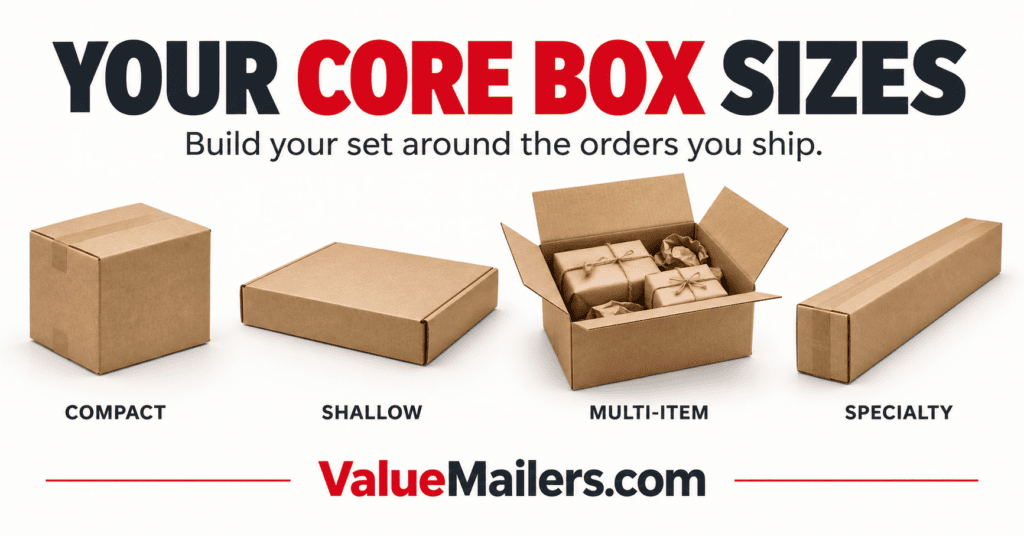
| Compact single-item box | Your common small, rigid products | Enough room for the required protection, without forcing or compressing the contents |
| Shallow or flat box | Low-profile items and suitable flat bundles | Depth that avoids a tall column of empty space while protecting corners and surfaces |
| Regular multi-item box | Your frequent two-item or three-item combinations | Separation between items, stable positioning, and a packing sequence staff can repeat |
| Specialty box, when justified | Records, long items, unusually fragile products, or another recurring exception | A shape and construction suited to that product—not just a larger general-purpose carton |
These are roles, not mandatory purchases. One size might cover two roles. Another business may need several multi-item sizes. Let the order mix and protection requirements decide.
Choose dimensions only after a packing trial
Measure the product with its intended cushioning and any separators in place. Compare that space requirement with the supplier’s stated box dimensions, checking whether they are internal or external. Do not assume the advertised dimensions equal the sealed package dimensions.
For example, 4x4x4 boxes, 6x4x4 boxes, 8x4x4 boxes, and 8x6x6 boxes are options to compare—not a recommended kit for every seller. Your products may need entirely different sizes.
Pack representative orders in each candidate. Check closure, bulging, movement, surface contact, and how consistently different staff can repeat the pack. A simple fit check is not a substitute for transit testing when products are fragile or damage risk is high.
Compare total packed cost—not just the box price
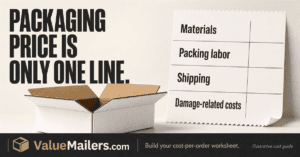
For each option, add packaging, cushioning, tape, packing labor, and a current shipping quote using the final sealed dimensions and weight. Consider damage and replacement costs separately using your own records. A cheaper carton is not a saving if the complete order costs more to prepare or deliver.
Illustrative example—not a ValueMailers packing test: suppose one box saves $0.12 in materials but takes 20 extra seconds to pack. At an assumed labor cost of $24 per hour, that extra time costs about $0.13. The material saving has already disappeared before considering postage or damage. Replace these assumptions with your own measurements.
Do not force every order into a box
Some durable, non-fragile products may suit a poly mailer. Others need cushioning, rigidity, or protection that a mailer cannot provide. Compare the options in our box vs. bubble mailer vs. poly mailer guide. Removing an unnecessary carton from an appropriate order can also simplify your box inventory.
Give each core size a clear job
Label shelf locations and make a short packing reference showing which order combinations use each size, the protection required, and when to choose an exception. Keep reorder points tied to actual usage and supplier lead times. Do not remove an existing size until its replacement has been tested on the orders that use it.
Review the set when your product mix changes, bundles become popular, or a rarely used size starts occupying valuable space. The goal is not to own the fewest boxes. It is to make safe, right-sized packing easier to repeat.
Your next step: select a representative batch of recent orders, identify the three most useful box roles, and trial the candidates before buying deeply. Build the core set your business needs—not the one that simply looks tidy on a shelf.