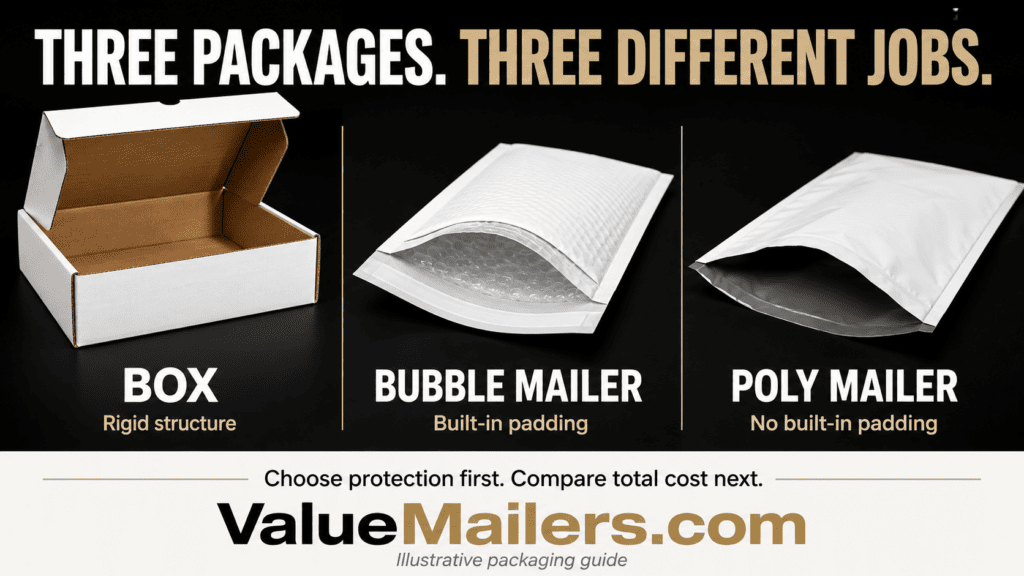
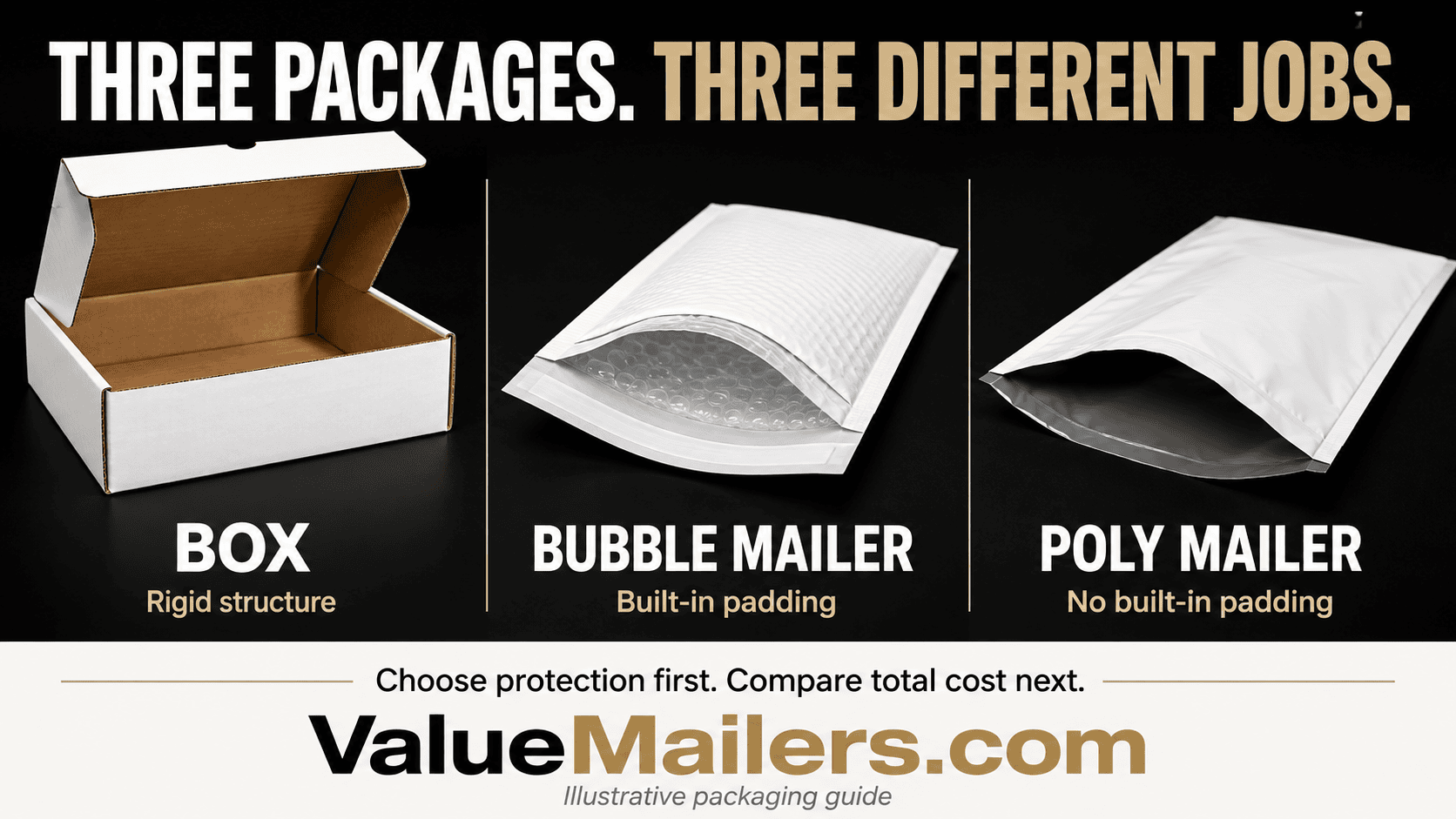
When comparing mailers vs boxes, start with protection. Choose a corrugated box when an order needs rigid support. For a durable item that needs padding but not rigid walls, consider a bubble mailer. Soft, non-fragile goods that need no added cushioning may suit an unpadded poly mailer.
That is the starting point—not a guarantee that every product in a category can use the same package. Once you know the protection requirements, compare the full cost of getting the order to the customer.
Mailers vs boxes: the quick decision guide
A flexible envelope, a padded envelope, and a rigid carton solve different problems. Start with the failure you need to prevent.
| Format | Useful starting point | What it does not provide | Reject this option when… |
|---|---|---|---|
| Corrugated box | Fragile, bend-sensitive, presentation-sensitive, or mixed orders | Automatic cushioning or movement control | Board strength, internal space, cushioning, or closure is unsuitable |
| Bubble mailer | Small, durable items needing a padding layer | Rigid walls that keep an item from bending or crushing | The product needs structural protection or strains the seams |
| Unpadded poly mailer | Soft, non-fragile goods such as a plain folded T-shirt | Built-in cushioning or rigid support | Contents can puncture it, lose their shape, or become damaged by compression |
A product that fits inside a package is not necessarily protected by it. A retail gift box may fit in a poly mailer, for example, while its corners remain vulnerable to crushing.
Ask three questions before choosing packaging
- Does anything need to keep its shape? Glass, ceramics, bend-sensitive goods, and presentation boxes need a packaging system with suitable structural support. Start with a corrugated box or a purpose-built rigid mailer.
- If rigid support is unnecessary, does the item need padding? A small, durable accessory may suit a bubble mailer. Check protrusions, surface sensitivity, and closure fit before making it your default.
- If padding is unnecessary, is the item soft and non-fragile? A plain folded garment may suit an unpadded poly mailer. Decorations, hard components, multiple items, or presentation requirements can change that answer.
For example, a T-shirt by itself and a T-shirt bundled with a ceramic mug are different packing jobs. Choose for the most vulnerable part of the complete order, not just the largest item.
What each packaging option actually does
Corrugated boxes provide structure
A correctly specified box provides room for cushioning, separation, and movement control. It does not replace those protective layers.
Start with White Corrugated Boxes when a rigid outer package suits the order. For compact items, evaluate the fit and closure of White Corrugated Mailer Boxes. For an outer carton around a protected product or a multi-item order, compare White Corrugated Shipping Boxes.
Choose the actual construction and specifications, not the color. A white finish alone does not tell you the box’s strength, weight suitability, or cushioning requirements.
UPS packaging guidance treats a rigid box and appropriate internal protection as separate steps. Leave the space needed for the protective system rather than forcing a product into the smallest possible carton.
Bubble mailers add padding, not rigid walls
Bubble Mailers have a cushioning layer inside a flexible envelope. That distinction matters: padding does not turn the package into a crush-resistant box.
A durable plastic phone case without brittle or projecting parts may be a candidate. A collectible card that must stay flat, a glass bottle, or a crushable presentation box needs a different protection strategy.
The outer material and the inner protection are separate choices. Poly Bubble Mailers have a plastic outer layer; kraft bubble mailers have a paper outer layer. Neither label alone establishes rigid bend protection.
When parts inside a box need individual cushioning, Bubble Pouches or Bubble Out Bags can be inner protective layers. They are not automatically substitutes for an addressed, securely closed outer shipping package.
Unpadded poly mailers suit soft goods
Poly Mailers are flexible shipping bags. In this comparison, “poly mailer” means the unpadded version—not a poly bubble mailer.
A plain T-shirt or other soft textile may not benefit from a bubble lining. However, a garment with a rigid ornament, a sharp accessory, or a gift box should not inherit the same packing rule without review.
Check the exact bag’s film, seams, closure, and usable dimensions. Do not assume that water resistance means the complete shipment is waterproof.
Carrier suitability also matters. For example, FedEx’s U.S. polybag guidance recommends at least 3 mil thickness. Check current guidance for your service; a product being sold as a mailing bag does not establish suitability for every shipment.
Mailers vs boxes: compare the total order cost
The purchase price of a bag or box is only one input. A useful comparison is:
Materials + packing labor + shipping charge + average damage-related cost per order.
For planning, use your own costs. Include acquisition costs for supplies where applicable, and do not treat an unfamiliar package’s damage risk as zero.
| Input | What to record |
|---|---|
| Materials per order | Outer package, inner wrap, cushioning, tape, label, and insert costs; use your actual quantities and purchasing costs |
| Packing labor | Seconds from starting the pack to having the labeled parcel ready; include assembly, wrapping, sealing, and rework |
| Finished parcel | Actual packed weight and measured exterior dimensions, including bulges |
| Matched shipping quotes | Same origin, destination, ship date, service, account, and relevant options; enter the actual packaging type |
| Damage-related cost | Actual replacement/refund handling costs from comparable shipments; mark unknowns as unknown, not zero |
Only compare options that meet the product’s protection needs. A cheap package that fails that first check should not win because its spreadsheet total is lower.
Two small calculations worth doing
These examples use assumed inputs. They are not ValueMailers prices, measured packing results, or promised savings.
At an assumed labor cost of $24 per hour, saving 20 seconds of packing time represents:
20 ÷ 3,600 × $24 = about $0.13 per order.
Across 500 orders, the unrounded calculation gives $66.67 of labor capacity. That may free time for other work; it does not automatically reduce payroll by that amount.
Now suppose a packaging change saves $0.25 per order, but one additional damaged order costs $25 to resolve. The savings on 100 orders would be consumed by that one additional incident.
Neither calculation proves which package you should buy. Together, they show why packing time and product protection belong beside material cost.
Get a quote for the finished parcel
Do not assume a mailer always costs less to ship. Weigh and measure each sealed option, including any bulges, and obtain matched quotes using the actual package type.
A different package can change weight, dimensions, and applicable charges. Our shipping box costs comparison shows how package dimensions can change calculated billable weight. Lower billable weight does not establish a proportional reduction in postage.
Mailers vs boxes: check usable space before buying
Nominal package size is not enough to confirm fit.
For example, the ValueMailers #1 poly bubble mailer is listed as 7.25 × 12 inches, with stated usable space of 7.25 × 11.25 inches. That allowance is specific to this product; do not apply it to every mailer.
Thickness uses space too. A three-dimensional item takes up more of a flexible mailer’s width and length than a flat sheet does. Trial-fit the protected item, not just the bare product.
Reject a size if the closure cannot seal normally, corners pull at the film, the seams are strained, or required cushioning has to be removed to make it fit. For a box, confirm the stated dimension convention and measure the completed exterior before quoting shipment costs.
Pack faster with a rule for each common order
A shelf full of options can slow the packing station if nobody knows which one to choose. Give each frequent product a default package and a clear exception rule.
Start with a short, repeatable check:
- Select one common product and two packaging options that both appear suitable.
- Pack several sample orders in each. Record the complete packing time, not just how fast the closure seals.
- Inspect the product, support, closure, and label position. Rework counts as packing time.
- Measure and weigh each sealed sample, then obtain matched shipping quotes.
- Record the chosen package, inner protection, packing steps, and exceptions. Review the rule when products, materials, or order combinations change.
These are screening steps, not proof of transit performance. Fragile, valuable, or repeatedly damaged products may need a more rigorous packaging assessment. FedEx describes its Packaging Lab testing service as one option to explore.
An exception can be simple: “One plain T-shirt uses the approved poly mailer; an order with a rigid gift box goes to the box packing method.” The point is to make the decision repeatable without hiding product-specific risks.
Common questions about mailers vs boxes
Is a poly bubble mailer the same as a poly mailer?
Not in this guide. A poly bubble mailer has a plastic exterior plus a bubble lining. The unpadded poly mailer has no built-in cushioning. Read the product description rather than relying on the word “poly.”
Can I put a small box inside a mailer?
Sometimes, but evaluate the complete system. The inner box must provide the structural protection the item needs, and the outer mailer must fit and close without strain. A thin retail carton does not become a suitable shipping package just because a bag surrounds it.
Should vinyl records go in a bubble mailer?
Use packaging designed for the record’s flat shape and vulnerable edges. Record Mailers, with appropriate internal support and fit, are a more relevant starting point than a generic padded envelope. A bubble layer alone does not keep a sleeve flat or protect its corners from bending.
Choose the smallest suitable protection system
For mailers vs boxes, the winning option is not automatically the lightest bag or the strongest-looking carton. It is the package that meets the product’s needs and gives you a workable total order cost.
Start with one frequent order. Identify whether it needs rigid support, padding, or neither. Then check fit, time the packing, and compare matched quotes before buying the next case.