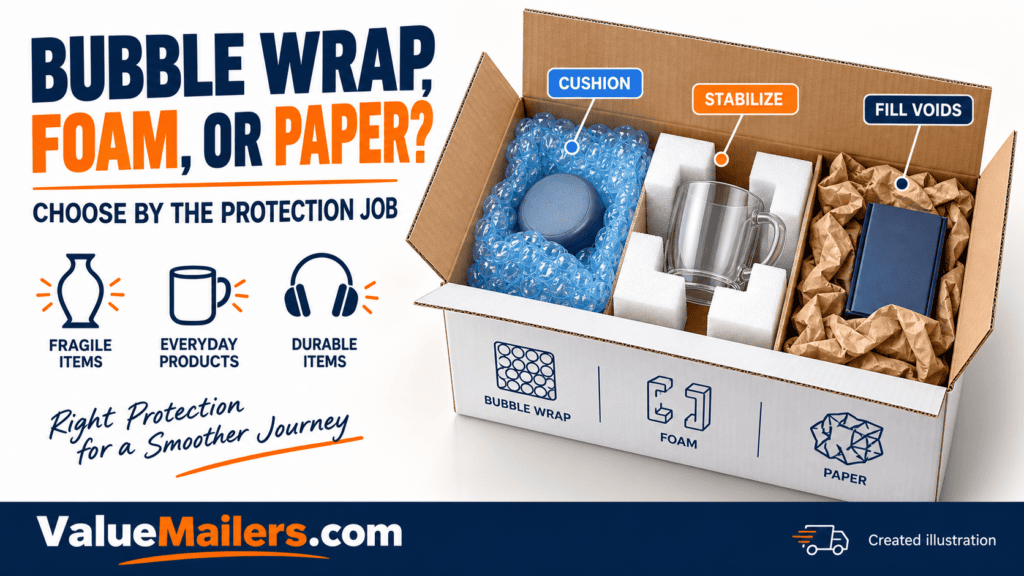
Bubble wrap, foam, and paper do different jobs. Use air-cell cushioning when an item needs a cushioning layer around its surface, foam when a fragile or rigid item needs more controlled stabilization, and tightly crumpled paper when a suitable box has empty space that needs to be filled. Start with the product’s risks—not the material you happen to have at the station. These roles overlap: foam and engineered paper systems can also cushion. Material form, thickness, density, product weight, and the complete package design matter.
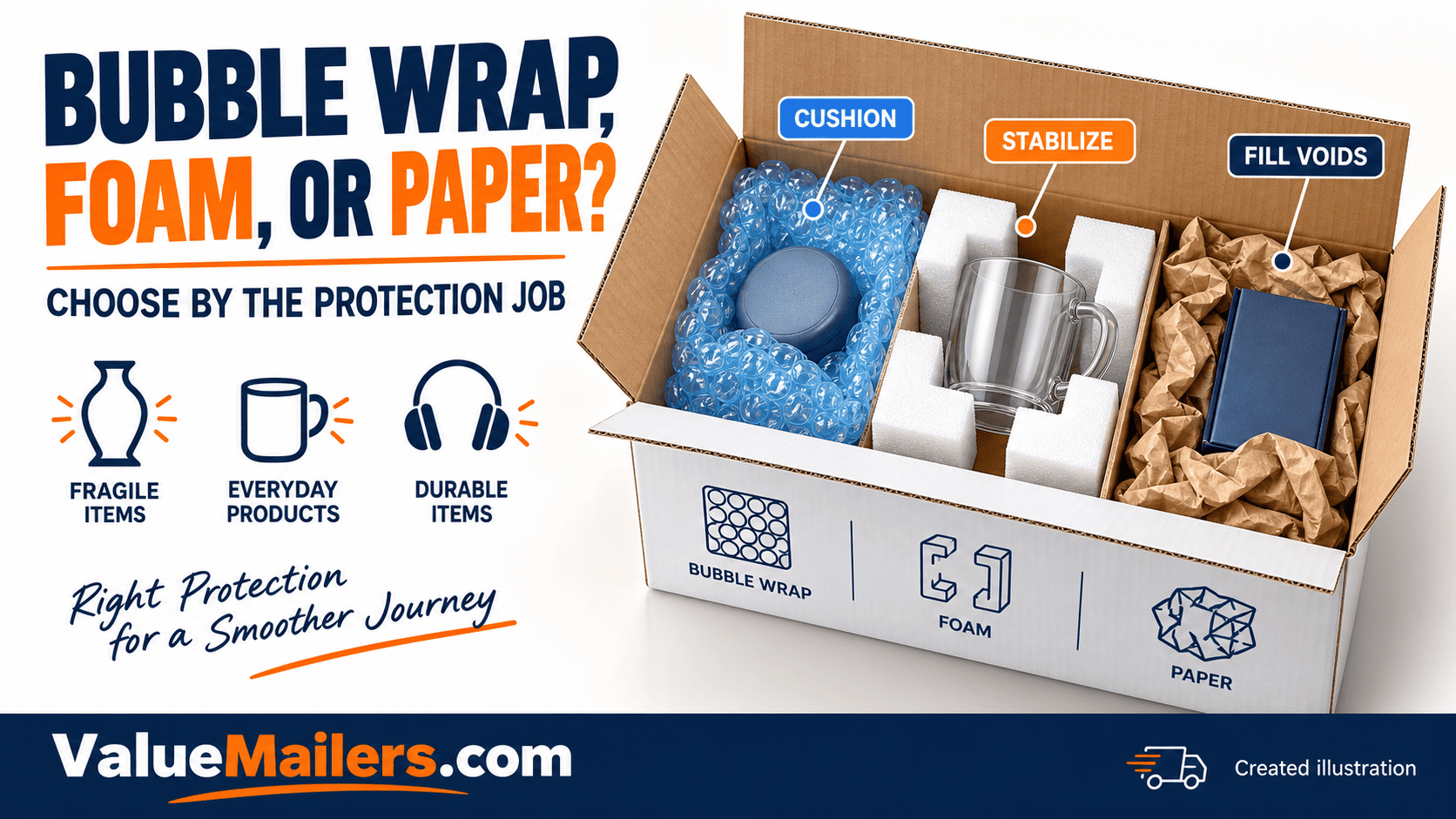
Choose the job before the material
A package can fail because a product rubs, strikes a box wall, moves through open space, or has an exposed corner. Identify the main risk, then choose a material and outer package that address it. FedEx advises choosing a box that leaves room for suitable cushioning and restricting movement; UPS distinguishes air-cellular cushioning from tightly crumpled kraft paper used as void fill.
| Protection job | Practical material role | Check before sealing |
|---|---|---|
| Cushion a product surface | Air-cell cushioning can surround a product and soften contact. | Corners are covered; the item is not forced into an undersized box. |
| Stabilize a rigid fragile item | Foam pieces, corner blocks, or an insert can hold a repeatable position. | The product is supported without pressure on vulnerable parts. |
| Fill empty space | Tightly crumpled kraft paper can occupy voids around a suitable inner pack. | The package does not allow ordinary movement after closure. |
Use the material that matches the job
Bubble wrap: surface cushioning
Use a cushioning layer around corners, edges, and irregular shapes, then select a suitable outer package and fill remaining space. For small, light, low-risk orders, compare Bubble Mailers. For compact items needing a separate cushioning layer, consider Bubble Pouches or Bubble Out Bags; check usable dimensions, closure, and final packaging.
Foam: controlled stabilization
Foam is useful when a rigid fragile item needs a repeatable position or targeted support. It does not replace a suitable outer container. For compact products, compare White Corrugated Mailer Boxes. For heavier or more vulnerable shipments, assess White Corrugated Shipping Boxes.
Paper: void fill and light separation
Use tightly crumpled kraft paper to fill intentional empty space around a suitable pack. Flat sheets do not stabilize a product the same way. Packing Tissue Paper is useful for light separation and presentation, not as a substitute for a needed protective system.
Use the outer package to complete the system
Match the container to the complete protected order. Review White Corrugated Boxes by usable dimensions. For vinyl, use product-appropriate Record Mailers and a record-specific process rather than improvising a general carton.
Quick packing-station check
- Identify the primary risk: scuffing, impact, movement, or an exposed edge.
- Confirm the selected material performs that job.
- Confirm the complete pack fits without forced compression or unfilled space.
- Check normal handling does not allow movement.
- Document the method so another packer can repeat it.
Use Shipping Labels for clear final identification, with addresses and required markings unobstructed.
FAQ
Is bubble wrap always better than paper?
No. Bubble wrap can provide surface cushioning; tightly crumpled paper is often used as void fill. Select the role the product needs.
Can foam replace a shipping box?
No. Foam may stabilize an item but does not automatically provide a suitable outer package.
Can paper be used for fragile items?
It can be part of an approved method, but do not assume it provides the same cushioning or controlled support as another material. Validate the complete pack with representative orders before standardizing it.
Sources checked September 10, 2026: FedEx Packing Tips and How-to Guides, FedEx breakables guidance, and UPS Packaging Tips. Carrier guidance can change; confirm current service-specific requirements before shipping.