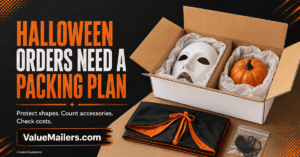
Your Halloween packaging inventory should serve October orders without becoming a November storage problem. Start with packaging that fits your products year-round. Then add a small, removable seasonal touch and buy it against realistic demand, not the size of the supplier’s discount.
The scariest box in your business might not contain a broken product. It might contain 400 unused pumpkin sleeves you paid for, stored, and now have no reason to open.
Halloween packaging inventory has two different clocks
A useful shipping box can keep working after the holiday. However, an insert that says “Happy Halloween 2026” has a much shorter window. Treat those two items as separate buying decisions.
Keep the protective base tied to product fit and ordinary order volume. Keep seasonal artwork tied to the remaining seasonal selling window. This distinction lets your business look festive without making every component a holiday commitment.
Shopify’s inventory guidance identifies unsold stock as a storage and cash problem, including merchandise whose selling season has passed. Apply that same discipline to your packaging supplies. A shelf full of unused decoration still occupies space and represents money already spent.
Choose a Halloween packaging base you can reuse
For compact, rigid merchandise, compare correctly sized White Corrugated Mailer Boxes. A plain box can support different seasonal presentations with a change of inner card or sleeve. First, check its dimensions, closure, and suitability for the complete protective system.
If your products need a different carton format, review White Corrugated Boxes. White is a presentation choice, not a strength rating. Choose the actual specification for the shipment rather than assuming a clean appearance makes a box stronger.
For larger bundles or a protective outer carton, consider appropriately sized White Corrugated Shipping Boxes. Avoid a one-size seasonal box that forces small orders into excessive space or large orders into a tight fit.
Some flexible, non-fragile products may suit Poly Mailers. Meanwhile, Bubble Mailers can be candidates for appropriate lightweight items needing modest cushioning. Neither format replaces rigid support when the product needs it.
If you sell seasonal soundtrack records, keep suitable Record Mailers in the year-round base. Change the inner message for the collection, not the protection rule for the record.
Keep the Halloween look separate from protection
Use one clear seasonal element instead of redesigning every layer. For example, a small orange insert can carry the greeting, while the box and cushioning remain useful for later orders.
A paper sleeve can dress an inner presentation box. However, do not assume it is suitable as loose exterior shipping wrap. Keep decorations away from the shipping label, closure, and other functional areas. If presentation needs an outer carton, include that carton in your material and labor plan.
For individually packed small items, Bubble Pouches may provide a contained cushioning layer inside the appropriate outer package. For multiple compatible pieces, Bubble Out Bags can help keep surfaces apart. Choose protection for the item, even when the seasonal decoration is minimal.
Also, avoid loose glitter, decorative confetti, and similar extras that create cleanup or interfere with unpacking. A seasonal message does not have to add a handful of material to every order.
Audit Halloween packaging inventory before placing an order
Use this decision table before approving a seasonal purchase. It is a planning tool, not a promise of savings.
| Component | After October 31 | Buying question |
|---|---|---|
| Plain, correctly sized shipping boxes | Can serve suitable ordinary orders | Does the specification match our actual products? |
| Undated orange tissue or inner sleeve | May suit other collections if presentation still fits | Can we genuinely use the remainder, or are we just hoping? |
| Halloween-only printed insert | Limited to seasonal orders | How many eligible orders remain before our cutoff? |
| Dated Halloween carton | Very narrow reuse opportunity | Is the minimum order larger than plausible demand? |
| Pouches and cushioning chosen for product risk | Can serve the same products year-round | Have we separated protection needs from decorative choices? |
Build a Halloween packaging inventory reorder rule
Start with eligible orders, not total store orders. If only one product collection gets the seasonal insert, unrelated orders should not inflate the forecast.
A simple worksheet is: expected eligible orders before the cutoff, plus a stated allowance for damaged or spoiled components, minus usable seasonal stock already on hand. Use a range when demand is uncertain. Do not turn the optimistic end of that range into an automatic purchase.
For example, suppose a seller expects 120 eligible orders and already has 40 usable inserts. The starting gap is 80 inserts before any stated allowance. A supplier’s 500-piece minimum would need a separate justification. These counts are hypothetical, not ValueMailers sales data.
Next, check when replenishment would actually arrive. Supplies delivered after the remaining orders have shipped cannot rescue a shortage. Choose a smaller initial run when feasible, and record the last sensible reorder date.
Compare the total commitment: component price, inbound freight, setup charges if applicable, storage, and the effort to apply the design. A cheaper unit price does not always mean a smaller seasonal bill.
Check the packing step before buying the decoration
Prepare one representative sample using the actual product and protective system. Check whether the new insert hides a small accessory, catches on an item, or makes the closure awkward.
Then time the added step over several ordinary practice orders. Record your own results. We have not tested a packing-time saving for these designs, and an illustration is not evidence of a physical packing test.
If the seasonal step repeatedly disrupts packing, simplify it. One readable card may be easier to manage than a sleeve, ribbon, sticker, and loose filler applied to every order. The right choice depends on your workflow, not a photograph of a styled box.
Give Halloween packaging inventory an exit plan
Decide how leftovers will be handled before purchasing. Undated, suitable material can return to general stock. Halloween-specific material can be set aside only if its condition, storage needs, and next-season usefulness justify keeping it.
Count the remainder when the seasonal offer closes. Record what you bought, used, spoiled, and retained. This turns next year’s purchase into a decision informed by actual usage rather than memory.
Do not use a clearance offer as a reason to send unsuitable packaging. Likewise, do not call every unused sleeve “recyclable” without checking its materials and the collection options available to the customer.
Halloween packaging inventory checklist
- Separate year-round protection from short-life decoration.
- Count only orders eligible for the seasonal presentation.
- Check stock on hand, minimum quantity, and replenishment timing.
- Include freight and added packing effort in the decision.
- Keep seasonal elements inside the functional shipping system.
- Record a last reorder date and a leftover-stock plan.
Questions before you buy
Do I need custom Halloween boxes?
No. Appropriate plain packaging with an inner seasonal card or sleeve can create a seasonal look. Custom printing is a separate choice that needs a realistic quantity, budget, and fulfillment plan.
Should I keep leftovers for next year?
Only when they remain suitable and the storage commitment makes sense. Dated designs, changed product sizes, and damaged stock can undermine that plan. Check the actual remaining material before deciding.
Can I reuse the same protective layers for other holidays?
Yes, when the products and shipping risks are unchanged and the materials remain suitable. A holiday design should not change the protection a product requires.
Let the ghosts stay in the artwork
A strong Halloween presentation does not require a warehouse full of seasonal cartons. Choose a useful base, add a focused seasonal touch, and set a buying rule your team can explain.
For protection decisions, also read our Halloween order damage-prevention guide. Together, the two plans help you think about what reaches the customer and what remains on your shelves.