Board games are deceptively challenging to ship. A game may look sturdy in its retail box, but that box is designed to sit on a shelf—not to absorb drops, stacking pressure, moisture, or repeated handling in transit.
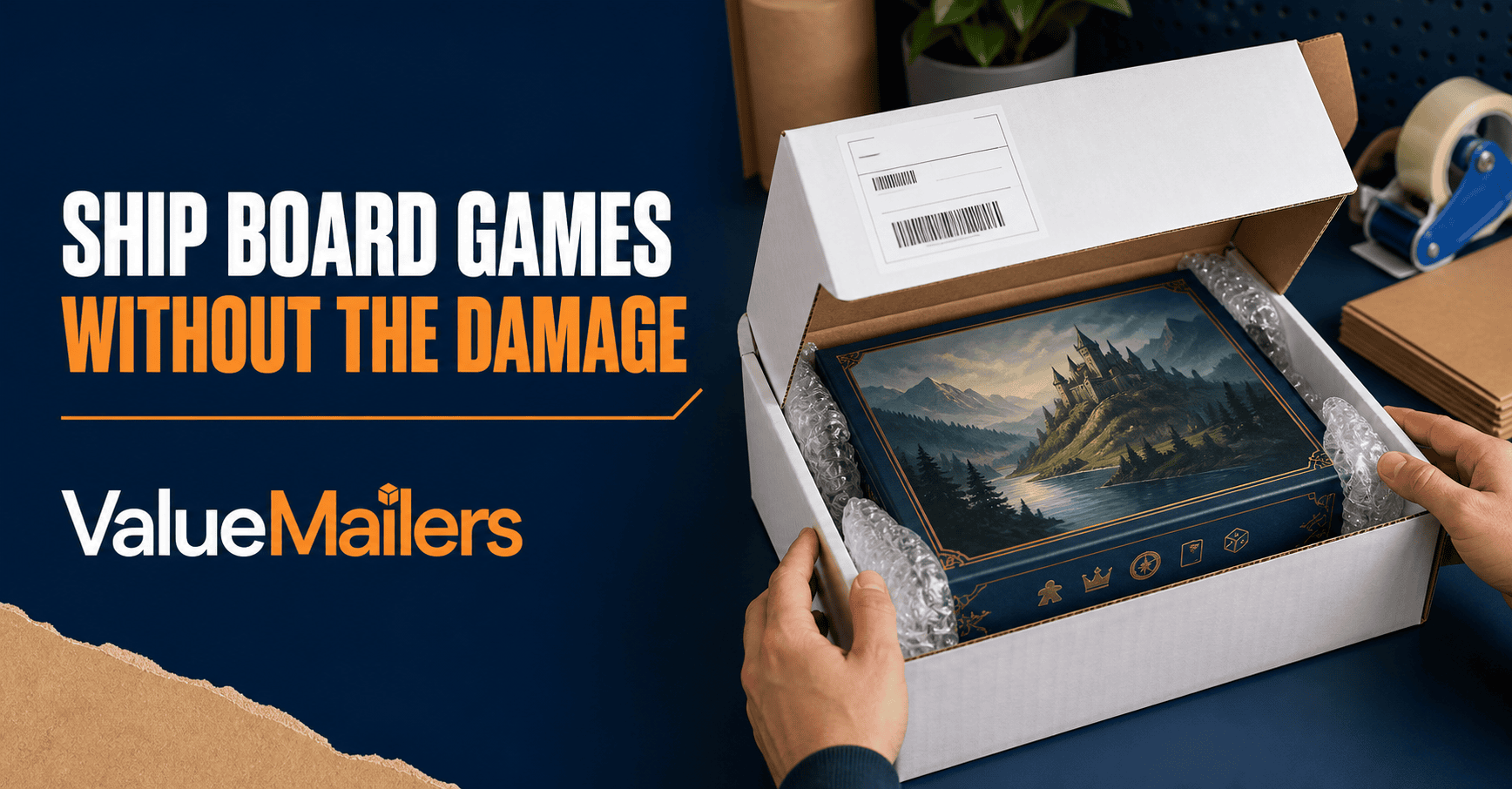
For ecommerce sellers, collectors, game publishers, and resale businesses, the goal is simple: protect the retail box and keep every component in place without adding unnecessary bulk. With the right board game packaging process, you can reduce crushed corners, split lids, scattered pieces, and disappointed customers.
Start with the game’s packed dimensions
Measure the board game after accounting for any protective layers. Record its length, width, height, and weight before choosing packaging.
A box that is too tight can crush corners or press against the lid. A box that is too large lets the game shift, which increases the chance of impact damage and may raise shipping costs. Choose the smallest sturdy box that leaves room for cushioning on every side. White Corrugated Boxes are a practical option when presentation matters as much as protection, while brown corrugated shipping boxes are a dependable workhorse for everyday fulfillment.
Secure loose components before packing
A board game can arrive with an unmarked outer box and still disappoint the buyer if cards, dice, miniatures, or tokens have scattered inside. Put loose tokens, dice, and small pieces into sealed bags or their original trays; secure card decks with a band, tuck box, or appropriately sized bag; and make sure the insert and rulebook are lying flat. If the lid lifts easily, add a light protective wrap around the retail box to keep it closed.
This step matters especially for used games, deluxe editions, and games with miniatures. It also helps the buyer enjoy a cleaner unboxing experience.
Protect the retail box and its corners
The retail box is part of the product. Creased artwork, scuffed edges, and crushed corners can reduce the perceived value of a game even when every component is intact.
Wrap the game in a protective layer before placing it in the shipping box. For compact games and delicate components, Bubble Pouches can provide a fast, consistent protective layer. For larger games, use cushioning material around the retail box, paying extra attention to the corners and lid edges.
Do not rely on a thin poly mailer alone for standard board games. Flexible packaging may be appropriate for certain low-risk, lightweight items, but most boxed games need the structure of corrugated packaging.
Eliminate empty space inside the shipping box
Once the game is inside its outer box, gently test for movement. If the game slides, rattles, or shifts when you move the carton, add void fill. Use enough cushioning to hold the game in place without packing it so tightly that the box bows outward. The best result is a package that closes squarely and keeps the game centered.
- Add a light base layer of cushioning.
- Place the protected game in the center.
- Fill the side gaps and corners.
- Add a top layer if there is vertical space.
- Close the box and perform a gentle shake test.
If movement remains, add more fill. If the carton is bulging, choose a larger box or reduce the amount of wrapping.
Seal the package for real transit conditions
Use quality packing tape on the center seam and reinforce the bottom seam when the game is heavy. For larger, heavier, or collector-grade games, consider using the H-taping method: tape the center seam and both outer edges on the top and bottom of the box.
Avoid covering key box seams with labels or tape that could pull away printed graphics from the retail packaging. The outer shipping box—not the game box—should carry the tape, shipping label, and handling marks.
Apply a clean, scannable shipping label
Place the label on the broadest flat panel of the outer box. Keep it away from seams, corners, and folds so carrier scanners can read it easily.
Use Shipping Labels that suit your printer and workflow, and make sure the barcode is flat, visible, and free from tape glare. Include a packing slip or contact information inside the package when practical, especially for higher-value games.
A “Fragile” label can communicate handling needs, but it is not a substitute for proper cushioning and a sturdy shipping box.
Match packaging to the type of board game
| Game type | Recommended packaging approach |
|---|---|
| Small card game or expansion | Use a right-sized corrugated mailer with light cushioning. |
| Standard family board game | Use a sturdy corrugated shipping box with corner protection and void fill. |
| Deluxe or miniature-heavy game | Secure components individually, use extra cushioning, and consider double-boxing. |
| Collectible or out-of-print game | Protect the retail box thoroughly and use a larger outer box with cushioning on all sides. |
| Multiple games in one order | Pack each game so the boxes cannot rub, crush, or shift against one another. |
For especially valuable games, insurance and signature confirmation may be worth considering based on the order value, delivery destination, and carrier service.
Avoid these board game shipping mistakes
- Shipping the retail box without an outer carton.
- Choosing an oversized box and leaving empty space.
- Forgetting to contain loose pieces before shipment.
- Using too little corner protection.
- Applying a label across a seam or fold.
- Adding so much material that the carton bulges.
- Estimating postage from the game’s weight instead of the final packed weight and dimensions.
Create a simple packing rule for each repeat SKU. For example: “standard game + bubble pouch + 14 x 10 x 4 box + side fill.” That consistency makes fulfillment faster and reduces packing errors during busy periods.
Build a reliable board game packaging station
Keep frequently used packaging supplies within easy reach: corrugated boxes, cushioning, tape, labels, bags for loose pieces, and a scale. A repeatable station helps small teams pack orders quickly without compromising protection.
The same principle applies across collectible categories. For instance, sellers use record mailers to protect the particular risks of vinyl shipments; board games need their own right-sized, structured protection rather than a one-size-fits-all package.
Final checklist before shipping a board game
- Loose components are secured.
- The retail box is protected.
- The outer corrugated box fits properly.
- There is no internal movement.
- All seams are securely taped.
- The shipping label is flat and scannable.
- Package dimensions and weight are accurate.
When you match the box, cushioning, and sealing method to the game’s size and value, board game shipping becomes a straightforward part of your ecommerce process—and your customers receive their games ready to play.