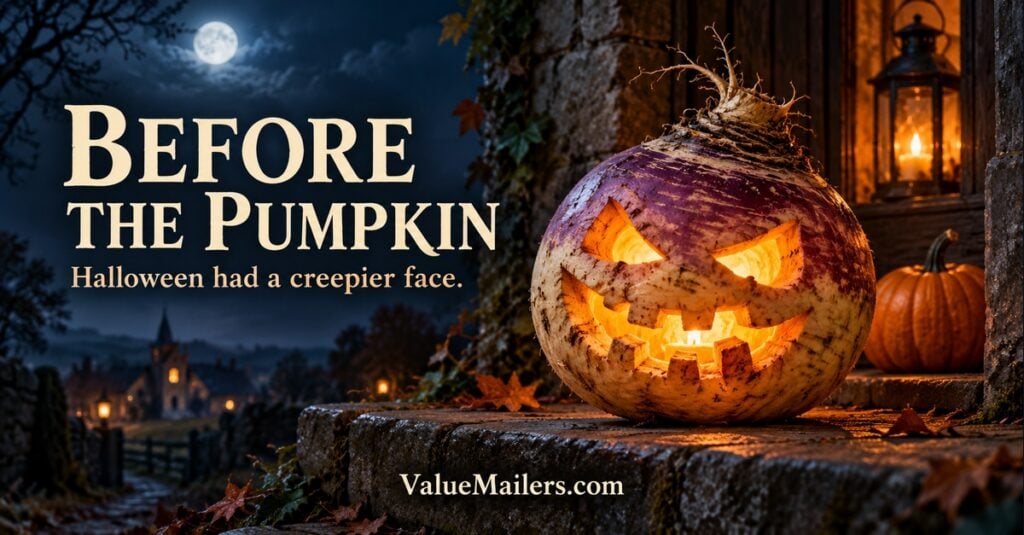
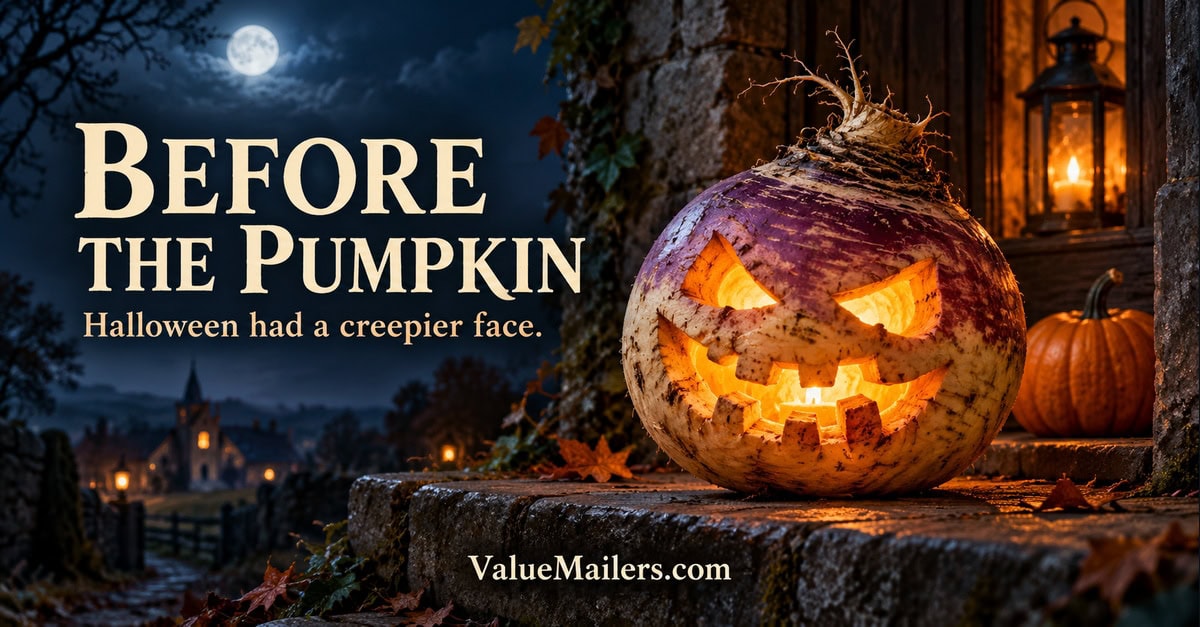
Imagine opening your front door on Halloween and finding a pale, hollow face staring back from the darkness. Long before pumpkin faces, turnip lanterns brought that fright to Halloween.
No bright orange pumpkin. No cheerful triangle eyes. Just a carved root vegetable with a light inside and an expression you would rather not meet halfway down a country lane.
Meet Halloween’s turnip lanterns: a tradition with enough atmosphere to make your plastic skeleton look friendly.
The pumpkin gets the spotlight today. Its eerie relative deserves a turn.
When turnip lanterns came from the vegetable patch
Carving a face into a turnip sounds like something invented for a spooky craft video. But the custom has a documented place in Halloween history.
Galway City Museum describes turnip lanterns once used across Ireland and Britain. People hollowed out the vegetables, cut faces into the shells, and placed candles inside. The lanterns could appear on walls and gates or hang from trees to startle people after dark. Read the museum’s account of the tradition.
Now picture that small light beside an unfamiliar path. You notice the glow first. Then the face.
Suddenly, a supermarket pumpkin feels like Halloween’s friendlier redesign.
A man named Jack—and a very bad afterlife
Then there is the story behind the lantern.
The Library of Congress recounts the Irish legend of Stingy Jack, a trickster who made bargains with the Devil. When Jack died, Heaven would not take him, and Hell would not admit him either. Left wandering, he carried a burning coal inside a carved turnip to light his way. Explore the Library’s Halloween history.
However, that is folklore, rather than a documented biography. But it gives the humble lantern a wonderfully unsettling role: a light carried by someone who can never arrive home.
Some Halloween decorations ask you to admire them. This one gives you a story to think about after you switch off the porch light.
Turnip lanterns and the museum’s ghostly keepsake
The National Museum of Ireland has a collection record titled “Ghost turnip.” In 1943, a teacher working near Fintown in County Donegal sent the museum a turnip lantern. She described it as the kind made in that area around 1900.
Here is the detail that makes the record especially interesting: the model described by the museum is a painted plaster cast created by museum artist Eileen Barnes. It is a preserved representation of the lantern, rather than a century-old vegetable that somehow escaped decay. See the Ghost turnip collection record.
Meanwhile, the museum also describes the familiar pumpkin lantern as an American development of the Irish tradition.
There is something fitting about that transformation. A temporary Halloween creation became an object people could keep studying long after its original night in the window.
A Halloween story worth putting in the box
For makers and small shops, that history offers a more interesting seasonal idea than another handful of plastic spiders.
If you sell ceramic lanterns, handmade ornaments, illustrated cards, or spooky collectibles, give the customer a small story to discover. For example, a short insert about turnip lanterns could make an appropriate companion to a Halloween order. Credit the historical source and explain how it relates to your design.
Keep the seller’s name easy to find. Let the surprise come from the story and the artwork, while the customer can still recognize the order.
A thoughtful detail does not have to be elaborate. One intriguing fact can give someone a reason to show a friend what arrived.
Give the ghost a safe trip
A ceramic lantern needs a different packing plan from a printed Halloween card. Choose protection around the item’s material, weight, and vulnerable details.
For breakable decorations, compare appropriately sized white corrugated boxes. Compact pieces may fit suitable white corrugated mailer boxes; larger arrangements may need white corrugated shipping boxes. Check the specifications and measure the protected item before choosing.
For compatible surfaces, Bubble Pouches or Bubble out bags can provide an inner cushioning layer. Separate pieces and secure them inside the outer box. Bubble Mailers are another format to consider for suitable lightweight items that do not need a rigid shell.
Finally, keep decorative extras clear of the closure and shipping label. The customer should be able to unpack the order without fighting through the Halloween scenery.
Would you put one on your doorstep?
With the story of turnip lanterns in mind, look at the pumpkin by your front door and imagine its stranger relative: a small carved turnip, a faint light, and the story of a wanderer with nowhere to go.
Would you give it a place beside your pumpkins—or leave that particular tradition to the museum?
At ValueMailers, we like a delivery with a good story. Let the face on the lantern give your customer a fright. Give the lantern a well-protected journey.