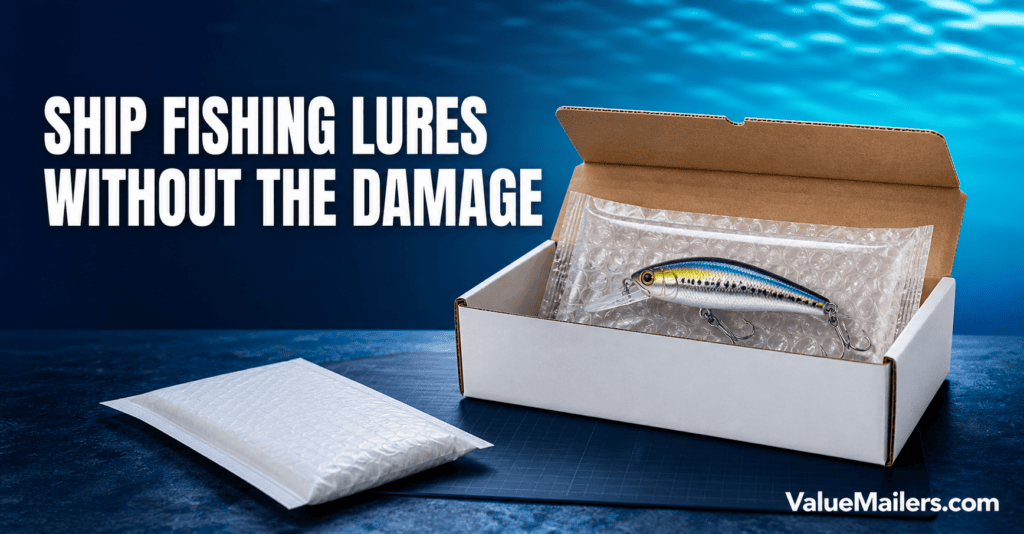
Selling fishing lures online means packing more than a small, lightweight product. A lure can have sharp treble hooks, a painted finish that scuffs easily, loose split rings, and an awkward shape that shifts in a package. The right shipping setup protects the lure, the package handler, and the customer opening the order.
This guide explains how to ship fishing lures safely, whether you are sending one packaged crankbait, a handful of jigs, or a small tackle bundle. The core rule is simple: immobilize sharp parts first, cushion the product second, then choose an outer package with enough structure for the order’s weight and risk.
Start with the lure type, not the cheapest package
Do not treat every lure as a flat accessory. A soft-plastic bait in its retail bag has different needs than a hard bait with exposed hooks. Before choosing packaging, check four things:
- Sharp points: Cover or secure hooks so they cannot snag, puncture a mailer, or scratch the lure.
- Packed dimensions: Measure the lure after its retail packaging, hook covers, backing card, and protective pouch are included.
- Movement: If it can rattle, rotate, or hit a box wall, add protection or use a closer-fitting package.
- Order value and weight: Heavy terminal tackle and collector-grade lures need a corrugated box sooner than lightweight replacement baits do.
For current carrier packaging requirements and restricted-item guidance, confirm the rules with the carrier you will use before mailing. USPS also recommends selecting a sturdy container and cushioning items so they cannot shift during transit in its packaging guidance.
The best packaging for common fishing-lure orders
| Order type | Recommended packaging | Why it works |
|---|---|---|
| Soft plastics in sealed retail bags | Padded mailer, if no sharp hardware is included | Adds light cushioning and helps protect the bag from scuffs. |
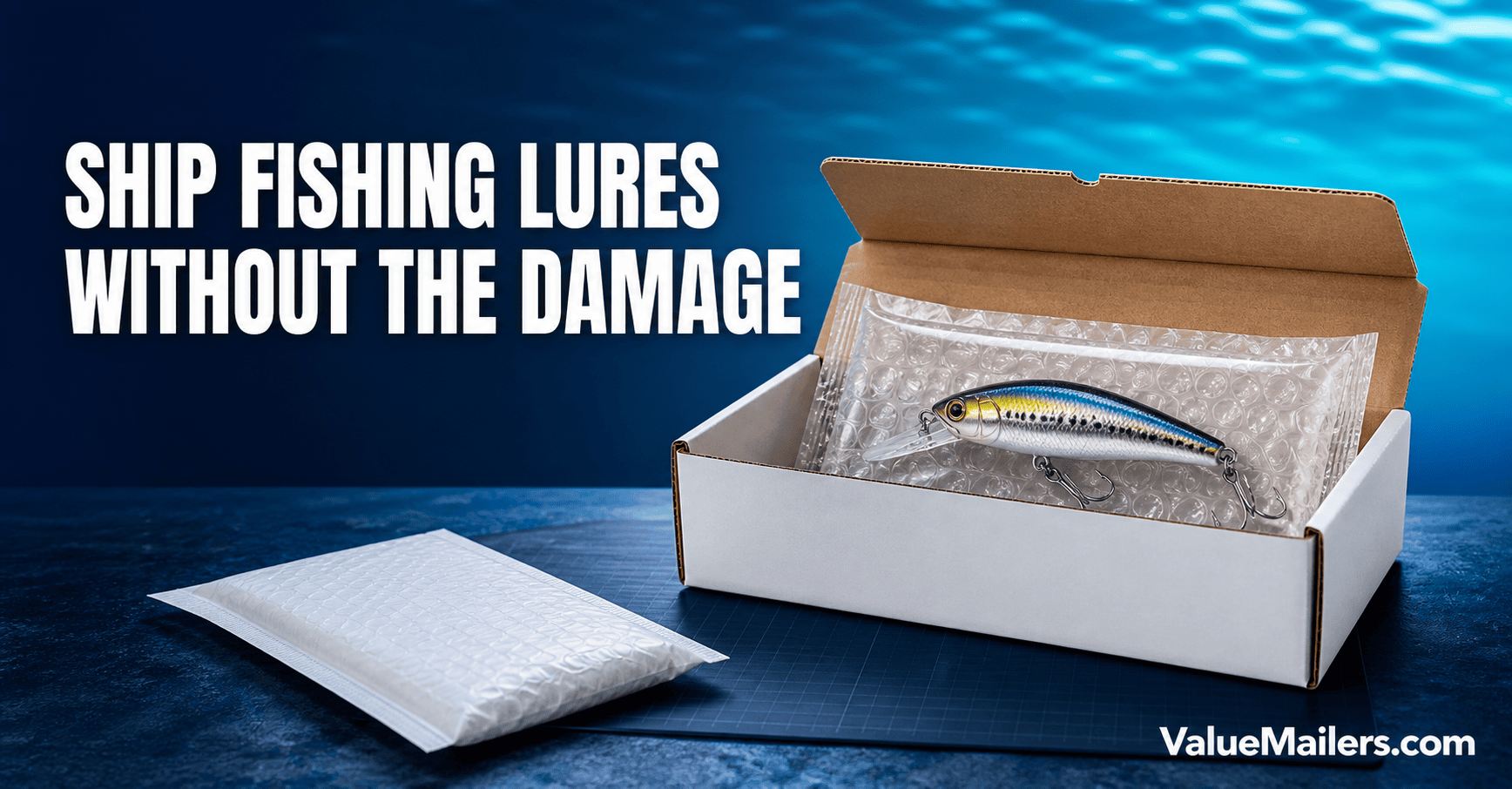
| One hard bait, jig, or spinner | Bubble pouch inside a close-fitting corrugated box | Contains hooks and protects the finish from impact and abrasion. |
| Multiple lures, weights, or tackle bundle | Corrugated shipping box with individual cushioning | Prevents the items from striking one another or escaping the package. |
Step 1: Secure hooks and loose hardware
Hooks are the first failure point. For a hard lure, fit hook caps when available, or use a small piece of protective material around the hooks before the lure goes into its inner package. Keep hooks from contacting the painted body, eyes, blades, or other lures. If a lure ships in a rigid retail clamshell or box, inspect that packaging first; it may still need an outer pouch and corrugated protection.
Avoid taping directly to a painted finish, a retail barcode, or a lure’s hooks. Tape can leave residue, pull graphics from a package, and make opening needlessly difficult. The goal is containment, not a permanent seal.
Step 2: Use an inner layer to protect the finish
For hard lures and metal tackle, a Bubble Pouches provides a fast, consistent inner cushion. Slide the item into the pouch, fold the adhesive lip over, and make sure no hook point is pressing directly against the seam. The same category is also a natural source for Bubble Out Bags, which place cushioning around small parts without the slower process of wrapping each item with loose bubble material.
Use a pouch for each hard lure in a multi-item order when finishes could rub together. Add a small amount of Packing Tissue Paper between retail boxes or around a boxed lure only when it eliminates motion; extra paper is not a substitute for a properly sized outer box.
Soft-plastic baits are different. Preserve the manufacturer’s sealed bag when possible, especially for scented or oil-treated baits. Place the retail bag flat in the outer package and do not combine it loosely with hooks, weights, or jig heads that can puncture it.
Step 3: Choose a mailer only for low-risk, flat orders
Bubble Mailers can be a good fit for flat, lightweight soft-plastic bait packs or already protected small accessories with no exposed sharp points. Choose a mailer that leaves room for the item to slide in without bending its retail packaging, but not so much room that the order shifts freely.
Poly Bubble Mailers are useful when the order is lightweight and you want a moisture-resistant outer surface. They provide cushioning, but they are not a substitute for a box when a lure has protruding hooks, substantial weight, or a rigid body that can be crushed.
Do not send a hard lure with exposed hooks in a padded mailer by itself. Even if the mailer seals, a hook can work through the padding during sorting. Put the lure in a protective pouch and a box instead.
Step 4: Upgrade to a corrugated box for hard baits and bundles
For most hard baits, jigs, spinnerbaits, and mixed tackle orders, a compact corrugated box is the safer choice. White Corrugated Boxes give small orders structure and a clean presentation. Choose the smallest size that accommodates the protected lure with a little room for cushioning.
If presentation matters for a gift, launch kit, or branded order, use a White Corrugated Mailer Boxes format that closes securely without excessive empty space. For heavier bundles or orders that will travel farther, White Corrugated Shipping Boxes provide the rigid outer layer needed to control impacts.
After closing the box, give it a gentle shake. If you hear movement, reopen it and add just enough tissue or a second pouch to lock the contents in place. A successful shake test is one of the easiest ways to reduce damage claims.
A repeatable packing workflow for fishing-tackle sellers
Use this five-step process at the packing station:
- Check the order for hooks, blades, weights, and fragile painted finishes.
- Cover hook points and keep hard lures from touching one another.
- Place each hard lure in a bubble pouch; keep soft plastics in their original retail bag.
- Choose a padded mailer only for flat, low-risk orders. Otherwise, use a close-fitting corrugated box.
- Perform a shake test, seal every seam fully, and apply a clear Shipping Labels label to the broadest flat panel.
For a growing store, write these choices into a simple packing rule: for example, “one bag of soft plastics = padded mailer; any hooked hard bait = bubble pouch plus box.” This saves time, trains new packers faster, and makes protection more consistent.
Common fishing-lure shipping mistakes
Relying on the retail package alone. Retail packaging is designed for display, not necessarily for carrier handling. It may crack, scuff, or allow hooks to move.
Putting multiple lures loose in one box. Blades, hooks, and hard bodies can damage each other. Separate them before they reach the outer box.
Using a package that is too large. Empty space creates momentum. Right-size the mailer or box, then cushion only the remaining gaps.
Using a mailer for a rigid, hooked lure. Padding helps with minor impacts, but it does not provide the puncture resistance or crush protection of corrugated board.
Choosing packaging by item category alone. A record mailer works well for record-sized flat media, but Record Mailers are not a one-size-fits-all answer for compact fishing tackle. Match the package to the packed dimensions, weight, and sharp edges of the actual order.
Frequently asked questions
Can I ship fishing lures in bubble mailers?
Yes, but only when the order is flat, lightweight, and has no exposed hooks or rigid parts likely to puncture or crush the mailer. Use a corrugated box for hard baits, jigs, spinners, or multi-lure orders.
How do I stop fishing hooks from puncturing the package?
Use hook caps or another protective cover, keep hooks away from seams, and place the lure in a bubble pouch inside a corrugated box. Test the package for movement before sealing it.
What is the best box size for fishing lures?
Measure the lure after its inner protection is added. The best box closes without pressing on the item and leaves only a small amount of space to cushion. Avoid oversized boxes that allow the lure to move.
Should I use tissue paper or bubble pouches?
Use bubble pouches when you need impact and scratch protection around the item. Use tissue paper as a light separator or gap filler after the item is already protected, not as the only defense for hard or sharp tackle.
Ship fishing lures with confidence
The safest way to ship fishing lures is to control the sharp parts, protect the finish, and use an outer package that matches the risk. A soft-plastic bait pack may travel well in a padded mailer. A hard lure with hooks belongs in a protected pouch and a close-fitting corrugated box.
Stock the right mix of Bubble Mailers, Bubble Pouches, and corrugated packaging before the next busy season. With a repeatable packing rule, every order can leave the warehouse protected, presentable, and ready for the trip to the customer.