2026 Ecommerce Packaging Trend Report
Ecommerce sellers are rethinking package size in 2026. Not just the big fulfillment teams. Not just national brands. Small businesses, Etsy shops, eBay sellers, Amazon FBM merchants, subscription-box operators, warehouse teams, and shipping departments are all asking the same practical question: why are we paying to ship empty space?
That is why lightweight ecommerce packaging has become one of the most important shipping strategies of the year. Sellers are not only buying supplies anymore; they are redesigning the way every order moves from shelf to carrier pickup.
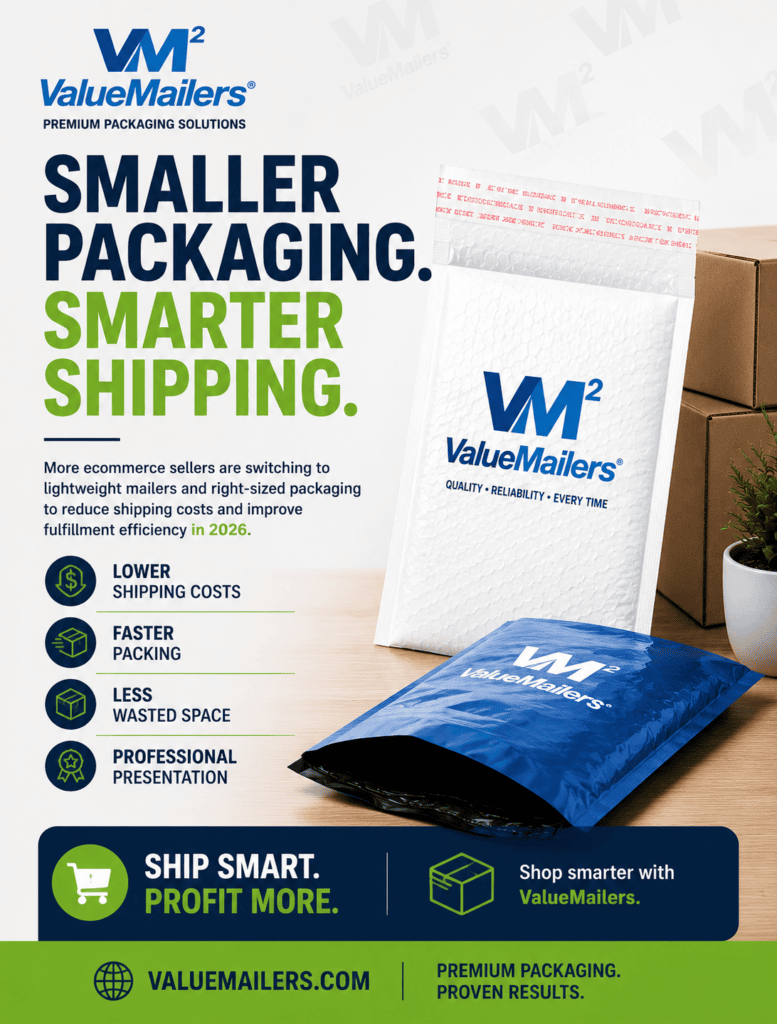
That question is turning into one of the biggest packaging conversations of the year. Sellers are moving away from oversized cartons, cutting down on void fill, and using more bubble mailers, poly mailers, fold-together cartons, and right-sized corrugated boxes. As a result, the goal is simple: reduce shipping costs, protect products, speed up fulfillment, and keep customers happy.
The shift toward lightweight ecommerce packaging is not a design trend. It is a margin trend. It is a fulfillment trend. And in 2026, it is becoming a survival strategy for online sellers who cannot afford to let packaging waste eat into every order.
Why Packaging Is Getting Smaller in 2026
For years, ecommerce growth rewarded speed above almost everything else. Sellers wanted the order out the door quickly, and if that meant using a box that was a little too large, many teams accepted the waste as a cost of doing business.
That thinking is changing fast. Shipping costs have become too important to ignore. Carriers now look closely at package dimensions, not just weight. Fuel surcharges remain a moving target. Residential delivery, peak demand, and handling fees can all push total shipment costs higher. A box that looks harmless on the packing table can become expensive once it enters the carrier network.
USPS recommended 2026 competitive price changes that included increases across major shipping services, including Priority Mail, Ground Advantage, and Parcel Select. UPS announced average net increases for published Daily Rates and Small Business Rates beginning in late 2025 for 2026 pricing. FedEx also published 2026 rate and additional-fee changes affecting shippers. These updates do not all hit every seller the same way, but they share one message: package efficiency matters more than ever.
For a small business, saving a few ounces or reducing a package by a few inches can matter across hundreds or thousands of orders. For larger warehouses, the impact compounds even faster. That is why packaging optimization is moving from a back-office detail to a front-line ecommerce strategy.
The Real Cost Driver: Dimensional Weight
Dimensional weight shipping, often shortened to DIM weight, is one of the biggest reasons sellers are shrinking packaging. DIM weight is a pricing method carriers use to account for package size. If a package is large but lightweight, the carrier may charge based on the space it occupies rather than the actual scale weight.
That means a lightweight item placed in an oversized box may cost more than expected because it takes up more room in a truck, van, or sorting facility. In other words, the seller is not just paying for pounds. The seller is paying for cubic space.
Dimensional weight rules vary by carrier, service, and account agreement, so sellers should always check their shipping software and carrier terms. But the underlying lesson is consistent: right-sizing packaging can help reduce surprise charges and improve shipping efficiency.
Dimensional Weight Examples
| Product | Oversized Package | Right-Sized Package | Why It Matters |
|---|---|---|---|
| Phone case | Small corrugated box with void fill | Protective bubble mailer | Lower material use and less empty space |
| Cosmetic compact | Box larger than the item | Small bubble mailer or compact box | Better fit and faster packing |
| Booklet or card set | Deep box with paper fill | Rigid mailer, record mailer, or flat mailer | Less movement during transit |
| Light apparel | Box | Poly mailer | Lower weight and easier fulfillment |
Why Lightweight Ecommerce Packaging Is Now a Profit Strategy
Packaging used to sit quietly in the expense column. In 2026, it sits closer to the profit conversation. Sellers are reviewing packaging because it affects almost every part of fulfillment:
- Shipping rate exposure
- Dimensional weight risk
- Warehouse labor speed
- Material cost
- Void-fill spending
- Storage space
- Damage rates
- Customer presentation
- Returns and replacement costs
When a seller chooses the right package, the entire order flow improves. Pickers move faster. At the same time, packers spend less time stuffing void fill. As a result, labels print with more predictable dimensions. The package takes up less room in staging. Finally, the customer receives a cleaner delivery experience.
For many teams, lightweight ecommerce packaging is now reviewed alongside product cost, marketplace fees, advertising spend, and carrier performance. Therefore, it belongs in that conversation because it touches every order before the shipment leaves the building.
That is why many teams now compare packaging the same way they compare shipping services. The question is not simply, “Does the item fit?” The better question is, “Is this the smallest protective package that makes sense for this order?”
Small Shipping Boxes Are Replacing Oversized Cartons
Small shipping boxes are becoming a key part of the 2026 packaging toolkit. Sellers still need boxes for fragile goods, stacked products, premium presentation, kits, glass containers, heavier items, and shipments that require structure. But instead of reaching for generic boxes, teams are building a tighter box assortment.
The rise of lightweight ecommerce packaging does not mean boxes are going away. It means sellers are choosing smaller boxes more carefully and reserving larger cartons for orders that truly need them.
That means more small cubes, slim cartons, and compact fold-together boxes. It also means using white corrugated boxes when presentation matters, and kraft corrugated options when durability and utility are the priority.
Fold-together boxes are trending because they help standardize packing. A packer can quickly assemble the right size, reduce tape use, and create a cleaner presentation. For small teams, that consistency is valuable. For fulfillment centers, it can reduce training time and speed up repeat workflows.
Bubble Mailers Keep Gaining Ground
Bubble mailers continue to grow because they sit at the center of three ecommerce needs: protection, speed, and lower weight. They are especially useful for products that need cushioning but do not need a rigid box.
For many online stores, bubble mailers are now the default for smaller orders. They are common for jewelry, cosmetics, accessories, media items, replacement parts, electronics accessories, trading-card supplies, small books, flat goods, and lightweight retail products.
The advantage is simple. A bubble mailer combines an outer shipping envelope with interior bubble cushioning. In addition, self-seal closures can speed up packing. The flexible format can reduce the wasted space that often appears inside a box. And because mailers usually weigh less than cartons with void fill, they can support shipping cost reduction goals.
This is where lightweight ecommerce packaging becomes practical. A seller can protect a small order without automatically adding a box, filler, and extra package dimensions.
For that reason, sellers looking for protective mailers often compare standard bubble mailers with VM2 bubble mailers, poly bubble mailers, and other lightweight shipping mailers to match product size, protection level, and presentation needs.
Bubble Mailers vs. Corrugated Boxes
| Packaging Type | Best For | Strength | Potential Drawback |
|---|---|---|---|
| Bubble mailers | Small, lightweight, non-crushable items | Low weight, fast packing, built-in cushioning | Less rigid than boxes |
| Poly mailers | Apparel and soft goods | Very lightweight, moisture resistant, compact | No bubble cushioning unless padded |
| Corrugated boxes | Fragile, stacked, heavy, or premium products | Structure and crush resistance | Can add weight and empty space |
| Record mailers | Vinyl records, flat media, prints | Flat protection and presentation | Product-specific use case |
The best packaging programs do not choose one format for every order. They create a practical mix: bubble mailers for small protected shipments, poly mailers for soft goods, corrugated boxes for structure, and record mailers for flat media protection.
How Smaller Packages Improve Fulfillment Speed
Shipping optimization is not only about carrier invoices. It also affects labor. A right-sized packaging program can make fulfillment faster because packers spend less time deciding, filling, taping, and correcting.
Oversized packaging creates extra steps. The packer has to add void fill, test product movement, tape more surface area, and sometimes remeasure the box. Smaller, predictable packaging removes friction from the packing table.
A strong lightweight ecommerce packaging program also makes training easier. New team members can learn which mailers, small boxes, and protective supplies match the most common products without memorizing a long list of exceptions.
Fulfillment centers often prefer mailers for products that qualify because mailers are easier to store, quicker to seal, and simpler to move through packing stations. For small businesses, the same benefits matter. A seller packing orders from a warehouse shelf, garage, office, or retail back room can save time by keeping the right lightweight shipping mailers within arm’s reach.
Packaging Optimization Examples for 2026
The most effective packaging strategies are practical. They do not require a complete warehouse rebuild. Instead, they start with product fit, order patterns, and packaging logic.
In most cases, lightweight ecommerce packaging starts with a simple audit: identify repeat orders, measure the current package, and ask whether the same item could ship safely in a smaller mailer or compact box.
| Current Situation | Optimization Move | Possible Benefit |
|---|---|---|
| Small product ships in a medium box | Move to a bubble mailer or smaller carton | Less void fill, lower dimensional exposure |
| Apparel ships in boxes | Use poly mailers for soft goods | Lower package weight and faster sealing |
| Flat media ships loosely | Use record mailers or rigid mailers | Better product control and cleaner presentation |
| Warehouse stocks too many box sizes | Build a focused packaging matrix | Faster pack decisions and lower confusion |
| Fragile items move inside cartons | Use smaller boxes plus targeted cushioning | Less movement and less wasted filler |
A smart packaging matrix does not chase the smallest package at all costs. It chooses the smallest package that protects the product, fits the brand experience, and works with the shipping service.
Why Sellers Are Reducing Void Fill
Void fill can be useful, but it often signals that the package is too large. If every small item needs a handful of kraft paper, air pillows, or packing material just to keep it from sliding around, the package may need to be right-sized.
Reducing filler is one of the easiest ways to make lightweight ecommerce packaging visible inside the operation. The team sees less waste at the packing table, and customers see a cleaner package when they open the order.
Reducing void fill helps in several ways. First, it can lower material cost. Next, it can make the package look more intentional. It can also reduce packing time. In addition, it may reduce customer frustration when buyers open a large box and find a small item buried under filler.
This is one reason shipping supplies are being purchased more strategically. Sellers are not just ordering tape, boxes, and mailers in isolation. They are building systems that pair the right package with the right product.
Small Package Shipping Savings: Where the Gains Come From
Packaging savings do not come from one single place. They come from small improvements stacked across the order flow. A lighter mailer here, a smaller box there, fewer inches on a common SKU, less filler on a repeat product, and faster packing on the highest-volume orders.
That stacked-savings effect is why lightweight ecommerce packaging matters for sellers of every size. One improved package may feel small. Hundreds of improved packages can change the monthly shipping picture.
| Packaging Change | Primary Savings Area | Best Fit |
|---|---|---|
| Move from box to bubble mailer | Weight, void fill, labor | Small protected goods |
| Move from medium box to small box | Dimensional weight exposure | Compact products needing structure |
| Use poly mailers for soft goods | Material weight and storage space | Apparel and flexible products |
| Use record mailers for vinyl | Product fit and presentation | Records, prints, flat media |
| Standardize top SKU packaging | Labor speed and fewer errors | High-volume ecommerce operations |
For small sellers, these savings can protect margin. Meanwhile, for larger shippers, packaging changes can influence monthly freight spend, labor planning, and warehouse layout.
How Amazon, eBay, and Etsy Sellers Are Adapting
Marketplace sellers feel shipping pressure quickly because buyers compare total price, delivery speed, and presentation. The platform may bring the traffic, but the seller still has to absorb packaging decisions on every order.
For marketplace sellers, lightweight ecommerce packaging can help protect the gap between the selling price and the final profit. That gap is where shipping supplies, carrier fees, returns, and labor all meet.
Amazon FBM Sellers
Amazon FBM sellers often need consistency and speed. A clear packaging matrix helps them process orders quickly while protecting performance metrics. Lightweight ecommerce packaging can be especially useful for accessories, small household goods, media, and replacement parts.
eBay Sellers
eBay sellers often ship a wider mix of products. That makes flexible packaging choices important. Bubble mailers, poly mailers, small boxes, and specialty mailers help sellers match the package to the item without overbuilding every shipment.
Etsy Sellers
Etsy sellers care about presentation as well as protection. A smaller, cleaner package can feel more intentional than an oversized carton. Jewelry, cosmetics, craft supplies, stickers, stationery, and small handmade goods often fit well in protective mailers or compact boxes.
Customer Experience Still Matters
Right-sizing packaging should not mean cheapening the customer experience. The best smaller packaging still feels professional. It protects the order, arrives cleanly, and makes the buyer feel like the seller cared about the shipment.
The best lightweight ecommerce packaging choices look intentional. A compact protective mailer or clean small box can feel more professional than an oversized carton filled with loose paper.
For example, a compact protective mailer or clean small box can feel more professional than an oversized carton filled with loose paper. By contrast, a package that is too big can feel wasteful. Likewise, a package that is too flimsy can feel careless. The balance is the modern ecommerce challenge: smaller, lighter, faster, and still protective.
That is why many sellers pair lightweight mailers with branded inserts, clean labels, organized packing stations, and consistent package choices. Packaging is not only a cost center. It is part of the customer’s first physical interaction with the brand.
Sustainability Pressure Is Also Pushing Right-Sizing
Consumers are more aware of packaging waste than they were a decade ago. Sellers hear complaints when small items arrive in giant boxes. They also hear praise when packaging feels efficient and thoughtful.
Sustainability discussions in ecommerce often focus on material type, recyclability, and recycled content. Those topics matter. However, right-sizing is one of the most practical sustainability moves because it can reduce excess material before the package is even shipped.
Smaller packages can mean less filler, less storage space, and more efficient transportation density. Sellers should avoid making unsupported environmental claims, but they can confidently say that reducing unnecessary packaging waste is a practical operational improvement.
That makes lightweight ecommerce packaging part of the broader sustainability conversation. It focuses on avoiding excess material first, before the package even reaches the customer.
Carrier Trends Make Package Size Harder to Ignore
USPS, UPS, and FedEx all publish rate and fee updates that sellers should review regularly. In 2026, ecommerce operators are watching several areas closely:
Carrier changes are one reason lightweight ecommerce packaging is moving from a nice-to-have idea to a practical shipping discipline. Sellers need packaging that helps them stay flexible as rates, surcharges, and dimensional rules change.
- General rate increases
- Dimensional weight rules
- Additional handling fees
- Large package and oversize fees
- Fuel surcharges
- Residential delivery costs
- Peak or demand-related adjustments
- Dimension accuracy requirements
Official carrier pages are the best place to confirm details. USPS posts pricing updates through its newsroom and shipping resources. UPS provides 2026 rate information and surcharge details through its shipping support and rate guides. FedEx publishes rate-change and additional-fee updates for shippers. Sellers should review those resources alongside their shipping software reports and account agreements.
For example, helpful references include the USPS 2026 pricing announcement, UPS 2026 Daily Rates information, and FedEx additional shipping fee updates.
What Sellers Should Audit First
A packaging audit does not need to be complicated. Start with the orders that happen most often. High-volume SKUs create the biggest opportunity because small improvements repeat over and over.
If the audit shows too many oversized cartons, lightweight ecommerce packaging should become the next test. Compare smaller boxes, bubble mailers, poly mailers, and other options against real products rather than assumptions.
- Pull the top 20 products by shipment count.
- Record the current package used for each item.
- Measure the product and the package.
- Note whether void fill is required.
- Compare package weight and dimensions.
- Test whether a smaller mailer or box protects the item.
- Update packing instructions for repeat orders.
- Review carrier invoices after the change.
For sellers starting fresh, ValueMailers categories can help organize the packaging mix: bubble mailers for padded protection, VM2 bubble mailers for lightweight ecommerce mailer options, poly mailers for soft goods, corrugated boxes for structure, white corrugated boxes for a cleaner presentation, record mailers for vinyl and flat media, and shipping supplies for the supporting materials that keep fulfillment moving. Ultimately, that mix gives sellers more control over each order.
How to Build a Right-Sized Packaging Matrix
In practice, a packaging matrix is a simple decision guide that tells packers which package to use for each product or order type. It does not need to be complicated. In fact, the best versions are short enough to post at the packing station.
For lightweight ecommerce packaging, the matrix should identify which products can move from boxes to mailers, which products need compact boxes, and which products need specialty protection.
The matrix should answer three questions: What is the product? What protection does it need? What is the smallest approved package? Once those answers are clear, the packing team can move faster and make fewer judgment calls during busy shipping windows. As a result, fewer orders need last-minute package decisions.
Match Package Rules to Real Products
For example, a jewelry seller might use a small rigid jewelry box inside a bubble mailer. Similarly, skincare brands might use a compact corrugated box for glass jars, but a bubble mailer for sample packets or soft cosmetic accessories. Record sellers can use record mailers instead of trying to make a standard carton work for flat media. Meanwhile, clothing sellers might use poly mailers for soft apparel and reserve boxes for bundled or premium orders.
However, the point is not to force every product into the same package. The point is to remove unnecessary guesswork. When packers know the approved package before they touch the order, shipping becomes more consistent and less wasteful.
| Order Type | Recommended Packaging Logic | Reason |
|---|---|---|
| Small padded item | Bubble mailer or VM2 bubble mailer | Built-in cushioning with lower package weight |
| Soft apparel | Poly mailer | Flexible, lightweight, and easy to seal |
| Fragile small item | Small corrugated box plus targeted cushioning | Structure where crush resistance matters |
| Flat media | Record mailer or flat protective mailer | Better fit and less movement |
| Premium gift order | White corrugated box or clean branded presentation | Improves unboxing while staying compact |
The Hidden Warehouse Benefits of Smaller Packaging
Most sellers notice the shipping-cost benefit first. However, smaller packaging can also improve the warehouse itself. Mailers and compact boxes take less shelf space. Smaller cartons are easier to stage before carrier pickup. In addition, a focused packaging assortment can reduce clutter around packing tables.
Those warehouse gains are one of the hidden advantages of lightweight ecommerce packaging. It helps the operation feel cleaner, faster, and easier to manage during daily fulfillment.
For that reason, this matters during busy periods. When order volume jumps, messy packaging storage slows everyone down. Packers lose time searching for the right box, restocking supplies, clearing oversized cartons from the work area, and correcting packages that were chosen too quickly. A leaner packaging setup keeps the flow cleaner.
Smaller packaging can also support better inventory planning. Instead of buying many sizes in small quantities, sellers can focus on the sizes that match their highest-volume orders. Therefore, reordering becomes easier and teams are less likely to use a larger substitute because the right package is out of stock.
In 2026, warehouse efficiency is part of the shipping-cost conversation. The package is no longer just the last step before the label. It is part of the system that determines how quickly an order moves from purchase to carrier handoff.
What Not to Do When Shrinking Packaging
Smaller packaging only works when protection stays strong. Therefore, sellers should avoid shrinking packages so aggressively that products bend, crush, leak, rub, or arrive looking careless. A damaged order costs more than a slightly larger package.
Before changing packaging, test the fit. Shake the package gently. Next, check whether corners are protected. Then, confirm that the closure is secure. Also, make sure the label has a flat enough surface. Finally, review customer complaints and replacement rates after the change. Good packaging optimization is measured by total performance, not just the lowest possible material cost.
The goal of lightweight ecommerce packaging is smarter protection, not weaker protection. Instead, a package should become smaller only when the product can still arrive safely and professionally.
Sellers should also avoid unsupported marketing claims. It is fine to say a package is right-sized, lightweight, or designed to reduce unnecessary space when that is true. Be careful with environmental claims unless the material, certification, or disposal guidance supports the language. Modern shoppers appreciate efficiency, but they also expect honesty.
Packaging Trends to Watch Beyond 2026
The shrinking-packaging trend is likely to continue because it is connected to long-term ecommerce economics. When shipping networks become more capacity-conscious, package dimensions will stay important. Because customers expect faster delivery, packing speed will stay important. And as sellers compete on total order cost, packaging efficiency will stay important.
That is why lightweight ecommerce packaging is likely to remain a major topic beyond 2026. The sellers who build better packaging systems now will be better prepared for the next round of shipping changes.
Therefore, expect more sellers to build SKU-level packaging rules, use smaller box assortments, increase mailer adoption, review dimensional data more often, and design packing stations around their most common shipments.
The winning packaging strategy will not be one-size-fits-all. Instead, it will be right-size-fits-most: a practical mix of boxes, mailers, and supplies that matches real order behavior.
FAQ: Lightweight Ecommerce Packaging and Shipping Optimization
What is lightweight ecommerce packaging?
In short, lightweight ecommerce packaging refers to mailers, boxes, and shipping supplies designed to protect products without adding unnecessary weight or bulk. Examples include bubble mailers, poly mailers, compact corrugated boxes, and right-sized protective envelopes.
Why are ecommerce sellers using smaller packages in 2026?
Sellers are using smaller packages to reduce dimensional weight exposure, lower material waste, speed up fulfillment, and improve shipping cost control as carrier rates and surcharges continue to pressure margins.
What is dimensional weight shipping?
Dimensional weight shipping is a pricing method based on package size. If the dimensional weight is higher than the actual weight, carriers may charge based on the dimensional weight.
Are bubble mailers cheaper than boxes?
Often, bubble mailers can be cheaper for many lightweight, non-crushable products because they often weigh less, use less storage space, and require less packing material. Boxes remain better for fragile, heavy, or crush-sensitive products.
When should a seller use corrugated boxes?
Generally, use corrugated boxes when products need structure, stacking strength, crush resistance, or a more rigid presentation. Boxes are useful for glass, kits, heavier goods, and items that should not bend.
What products ship well in bubble mailers?
Bubble mailers are commonly used for accessories, jewelry, cosmetics, trading-card supplies, electronics accessories, small books, craft supplies, and other compact products that need cushioning but not a rigid box.
How can small businesses reduce shipping costs?
Small businesses can reduce shipping costs by right-sizing packaging, reducing void fill, comparing carriers, standardizing packaging for top SKUs, and using lightweight mailers where product protection allows.
Do smaller packages improve warehouse efficiency?
Yes. Smaller, standardized packages can help packers move faster, reduce decision-making, lower filler use, and make packing stations easier to organize.
Are poly mailers good for ecommerce fulfillment?
Poly mailers are useful for apparel, soft goods, and flexible products that do not require cushioning. They are lightweight, space-efficient, and quick to seal.
What is right-sizing packaging?
Right-sizing packaging means choosing a package that fits the product closely while still providing the required protection. It reduces empty space, excess filler, and unnecessary package dimensions.
Can packaging affect customer experience?
Absolutely. A clean, right-sized package can feel professional and thoughtful. Oversized packaging can feel wasteful, while packaging that is too weak can damage trust.
Should Etsy and eBay sellers use lightweight packaging?
Overall, many Etsy and eBay sellers benefit from lightweight packaging because they often ship small goods, handmade items, accessories, collectibles, and one-off orders where package efficiency protects margins.
How often should sellers review packaging choices?
Ideally, sellers should review packaging whenever carrier rates change, product mix changes, order volume grows, or damage and shipping costs begin rising. A quarterly packaging audit is a practical starting point.
Where can sellers find ecommerce shipping supplies?
ValueMailers offers ecommerce packaging options including bubble mailers, poly mailers, corrugated boxes, record mailers, and other shipping supplies.
Final Takeaway: Smaller Packaging Is a Bigger Business Decision
In 2026, ecommerce packaging is no longer just a box, bag, or mailer. It is a cost-control tool, a fulfillment-speed tool, and a customer-experience tool. Sellers who shrink packaging intelligently can reduce waste, protect margins, and build a smoother shipping operation.
The key is not to make every package smaller. The key is to make every package smarter.
Build a leaner 2026 packaging program
Explore ValueMailers shipping supplies for ecommerce sellers, including protective bubble mailers, lightweight poly mailers, compact corrugated boxes, white shipping boxes, record mailers, and fulfillment-ready packaging essentials.