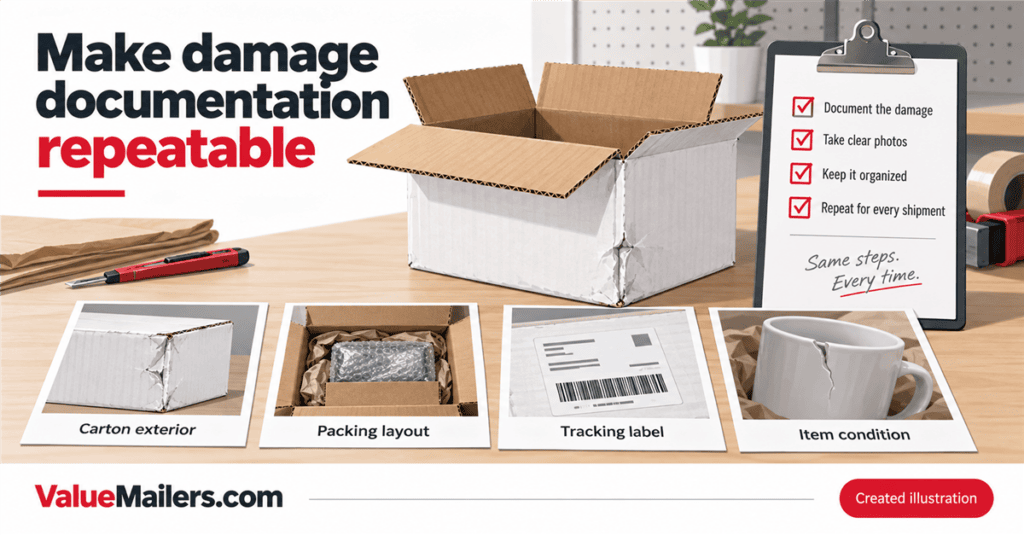
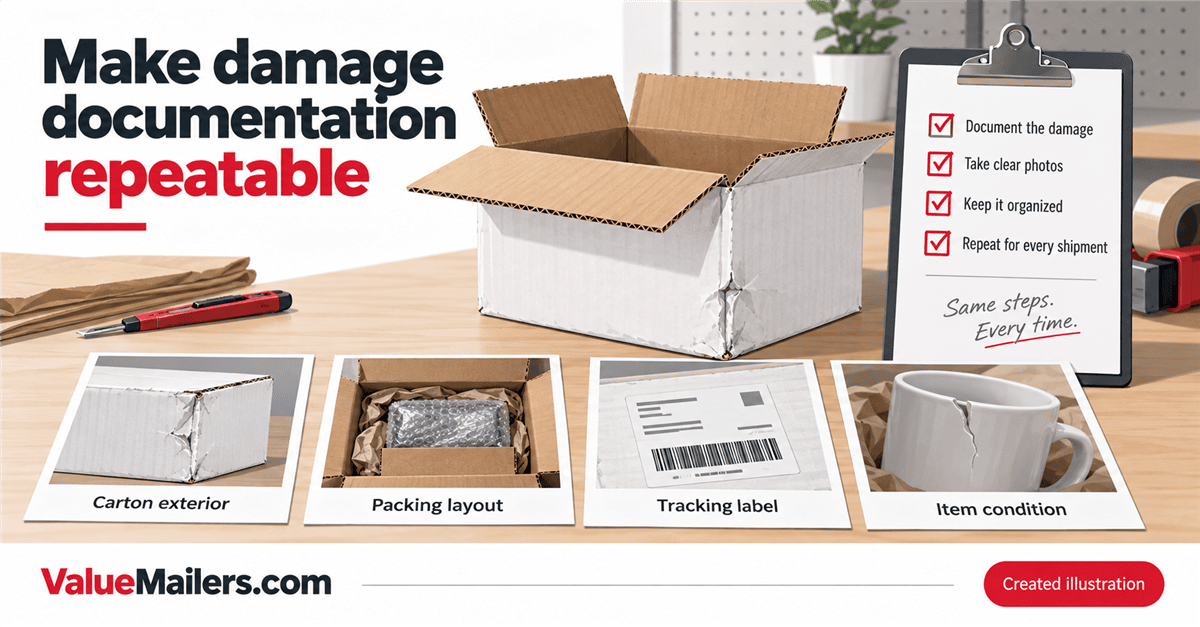
Shipping damage documentation starts before a parcel leaves your packing station. Photograph the finished package, then preserve and document the parcel, packing, label, and item condition if a customer reports damage. The goal is a clear record—not a guarantee that a carrier will approve a claim. Keep the original materials together until the carrier’s process is complete.
Why shipping damage documentation matters
A package can look different at handoff, delivery, and unboxing. A repeatable photo routine helps a small seller locate the shipment, explain what was packed, and respond without reconstructing the order from memory. It also helps you spot a packing pattern worth fixing.
Carrier requirements differ by service, shipment, and claim type. For example, UPS says damage claims require photo documentation and may require a physical inspection; FedEx says to keep original packaging for inspection; USPS says recipients must retain the container, packaging, contents, and damaged article until a damage claim is resolved. Check the applicable carrier’s current instructions before filing.
Before shipping: create a fast order record
Photograph item identity and the interior layout during packing, before sealing the parcel. Then photograph the sealed exterior and label before carrier handoff. Use a clean, repeatable spot at the packing station. A phone is usually enough when the image is in focus and the tracking information is readable.
| Photo | What to show | Why it helps |
|---|---|---|
| Finished exterior | Sealed parcel, all sides that matter, and a visible label | Connects the package condition to the tracking number. |
| Inside before closure | Item position, protective layers, and movement-control materials | Shows the packing layout without claiming a test result. |
| Item identity | Product, quantity, and serial number when relevant | Helps match the order, inventory, and later customer report. |
Keep the record lightweight
Do not create a separate administrative job for every order. Name photos with the order number and keep them in one controlled folder for the retention period your business chooses. Restrict access to customer information and avoid photographing more personal data than the label requires.
After a damage report: pause, preserve, document
Ask the customer not to discard, return, or reship the item and materials while you check the carrier’s instructions. This is especially important because inspection or additional documentation may be requested. Do not ask a customer to alter a package to make it look worse; accurate records protect everyone.
| Document | Capture clearly | Do not do |
|---|---|---|
| Outer parcel | Wide views plus close-ups of dents, tears, wet areas, or crushed corners | Throw away the carton or remove the label. |
| Interior layout | How the item and packing materials sat inside the package | Repack before recording the original arrangement. |
| Item condition | Damage from more than one angle; model/serial details where relevant | Claim a cause that the photos cannot establish. |
| Order proof | Tracking number, receipt/invoice, and item value or repair estimate when requested | Submit mismatched values or edited evidence. |
Match the protective system to the order
Documentation does not replace careful packing. Choose the outer format around the product’s rigidity, fragility, finished dimensions, and ability to move.
For compact rigid orders, compare White Corrugated Boxes with the fully protected item, not the bare product. If a close-fitting presentation-oriented format is suitable, evaluate White Corrugated Mailer Boxes by usable dimensions and specifications.
When an order needs a more substantial outer container and room for its protective system, review White Corrugated Shipping Boxes. Do not choose a carton only by color or by the item’s unprotected dimensions.
For low-risk, flexible goods that need modest cushioning rather than rigid protection, compare Bubble Mailers. A mailer is not a substitute for a box when the item can be crushed or needs movement control.
Inside suitable outer packaging, Bubble Pouches can separate and cushion individual items. Sellers using Bubble Out Bags should still verify fit, closure, and the outer container rather than treating a pouch as a complete protection plan.
For vinyl and other flat media, use appropriately sized Record Mailers and the support the item needs. Keep the record-specific packing process separate from a general carton workflow.
A simple shipping damage documentation workflow
- Find the order, shipment date, tracking number, and before-shipping photos.
- Tell the customer to retain the item, carton, packing, and label while you consult the carrier’s current requirements.
- Request clear exterior, interior, label, and item-condition photos—without directing a customer to manipulate evidence.
- Collect the order-value and repair/replacement documents the applicable process asks for.
- Review the package photos later for a specific packing improvement, rather than assuming every damage report has one cause.
Frequently asked questions
Should I photograph every package before shipping?
Use a level of documentation that fits the order’s risk and value. A consistent routine for higher-risk orders can be more workable than an elaborate routine that the team cannot sustain.
Do photos guarantee a carrier claim?
No. They can support an accurate submission, but carrier eligibility, timing, inspection, liability limits, documentation, and other conditions still apply.
Can the customer throw away the packaging after sending photos?
Not until you have checked the applicable carrier’s instructions and the claim is resolved. USPS, UPS, and FedEx all advise retaining original packaging in relevant damage-claim contexts.
Use records to improve the next shipment
A well-organized record helps with the immediate customer conversation, but its longer value is operational. Review repeat issues by product type, container fit, internal movement, and handling pattern. Then change one part of the packing process, document it in your team standard, and keep the next shipment record equally clear.
Carrier guidance checked September 15, 2026: UPS claims guidance, FedEx claims guidance, and USPS Domestic Claims basics. Requirements can change; verify the service-specific rules before acting.