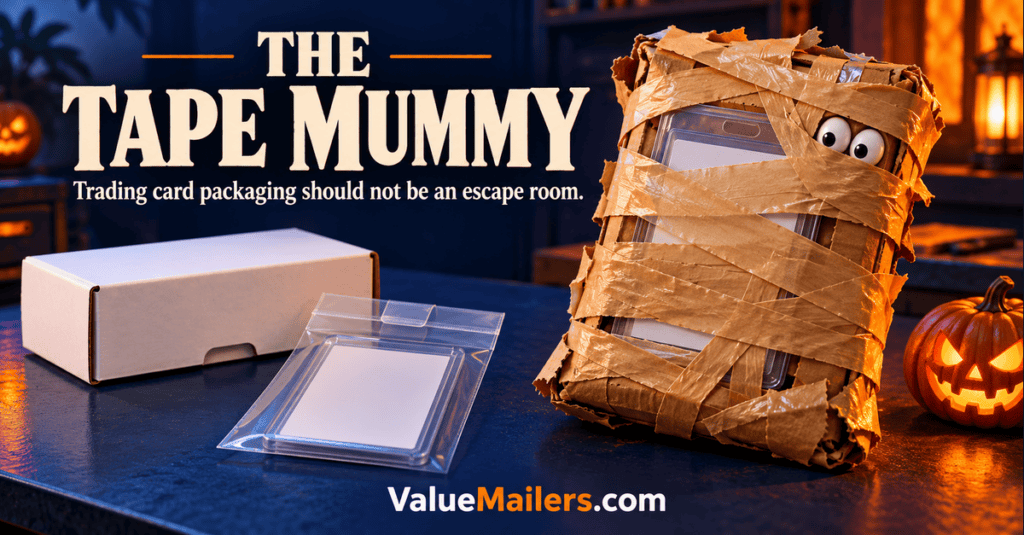
The rare card arrived. The corners look sharp. There is just one problem: the buyer cannot find a way in. Your trading card packaging has become a tape mummy.
A cardboard sandwich disappears beneath overlapping strips. The holder’s opening is buried. Every possible starting point seems dangerously close to the card. That is a Halloween scene no collector needs.
Good packaging has two jobs: protect the order during shipping and give the recipient a clear way to remove it. This article focuses on that second job. For the protective layers themselves, start with our complete guide to shipping trading cards safely.
The last few inches of the delivery journey
Think about the moment after delivery. A customer has to open the outer package, remove the protected bundle, and reach the holder. Each step should lead naturally to the next.
However, more wrapping does not automatically make that sequence clearer. For instance, extra tape can cover an opening that worked perfectly two layers ago. For example, a tightly wrapped bundle can also leave no obvious place to grip disposable packaging without pressing on its contents.
Ultimately, the goal is not less protection. Instead, it is protection with a visible opening route. Keep secure outer seals, suitable cushioning, and movement control. Then make the inner layers understandable.
Three trading card packaging traps to banish
1. The seam that vanishes
You know where the cardboard opens because you packed it. However, your buyer does not. If several layers hide the starting edge, the recipient has to guess.
Give disposable inner wrapping an obvious starting point. For ordinary customer shipments, a clearly marked opening edge can help. If a folded tab is appropriate for that disposable layer, keep it away from the card and holder opening. It must not leave the package unsecured.
2. The adhesive ambush
In trading card packaging, tape belongs on the layer it is meant to close. However, it should not touch the card. Likewise, avoid sticking tape to a collectible graded slab or placing exposed adhesive where the card will slide out.
Use an appropriate protective bag or other separate inner layer when the closure needs separation from the holder. Check that the card cannot slide toward exposed adhesive. Finally, leave the holder’s own opening accessible after the disposable wrapping comes off.
3. The cardboard bear hug
Similarly, a rigid sandwich can become awkward if the buyer must bend it to release the holder. The same problem appears when cushioning is packed so tightly that removal requires squeezing the collectible.
Instead, choose a fit that controls movement while leaving a sensible removal sequence. The buyer should be able to handle the protective layers, not use the card as a handle. Do not solve a difficult opening by leaving the card loose.
Give your trading card packaging an opening check
Before the next valuable order, make a sample package with a dummy card or another nonvaluable substitute. Use the same holder, wrapping, and outer package you plan to ship.
Next, hand it to someone who did not pack it. Ask them to open it without coaching. Stop the check if their approach could damage the sample or cause an injury. This is a simple usability exercise, not a transit test or proof against shipping damage.
- Watch the first move. Can they identify the intended opening?
- Notice hesitation. Which layer makes them stop and search?
- Watch their grip. Are they handling disposable packaging or pulling on the card?
- Check the adhesive. Does any sticky surface enter the card’s removal path?
- Ask one question. “What would have made that easier to understand?”
Then change one confusing detail and try the sample again. You might move a label, expose a disposable opening edge, or change the inner bag size. Afterward, confirm that the revised package still closes securely and holds its contents in place.
A customer order is not a grading submission
Do not apply a buyer-friendly tab idea blindly to every shipment. Grading companies have their own preparation rules, and those rules take priority for submissions.
For example, PSA’s shipping guide calls for penny sleeves and semi-rigid holders. Its card-preparation instructions specifically exclude top loaders, tape, pull tabs, and sticky notes. Separately, PSA instructs submitters to seal the shipping box with packing tape.
Those are different layers with different requirements. Therefore, check the current destination instructions before packing. Our opening check is for ordinary customer orders; it is not a replacement for a grading company’s submission process.
Trading card packaging: choose layers with a purpose
Start with the order’s size, value, holder, and shipping service. USPS’s package guidance says packaging should be strong enough to protect its contents and should not bulge. An easy opening does not excuse an unsuitable outer package.
For compact boxed orders, compare white corrugated boxes and appropriately sized white corrugated mailer boxes. Larger protected bundles may need white corrugated shipping boxes. Check the actual internal fit rather than choosing by appearance.
Bubble Mailers may suit some properly protected orders, but they do not replace the rigid protection a card needs. Meanwhile, Bubble Pouches and Bubble out bags can add cushioning around suitable protected items. Choose dimensions that allow removal without tugging on the collectible.
Keep the Halloween surprise on the thank-you note
A small pumpkin sticker on a note can be fun. A holder trapped beneath a maze of adhesive is a different kind of surprise.
This season, look at your trading card packaging from the buyer’s side of the table. Protect the corners. Secure the shipment. Make the opening clear. The collectible should be the treasure—not the prize for escaping your packaging.