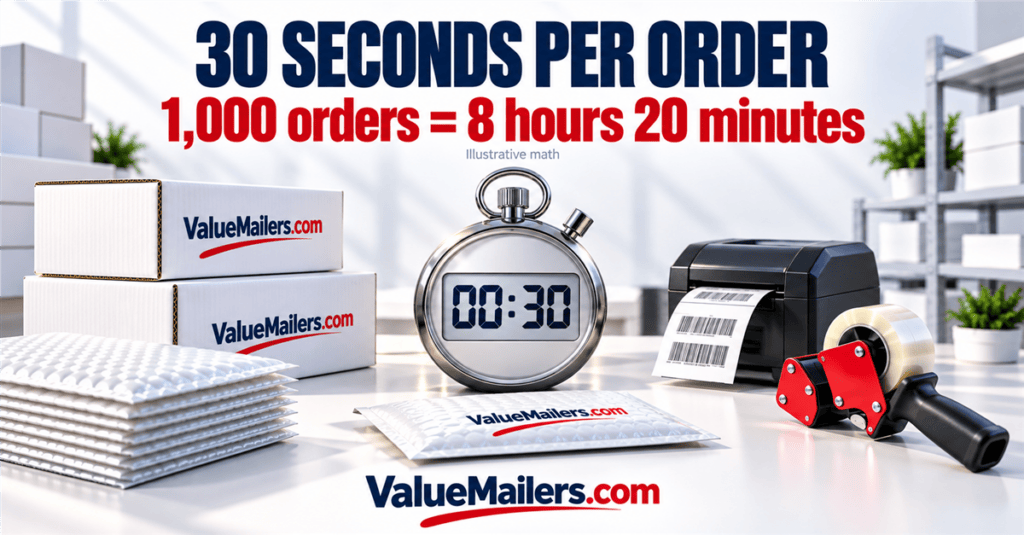
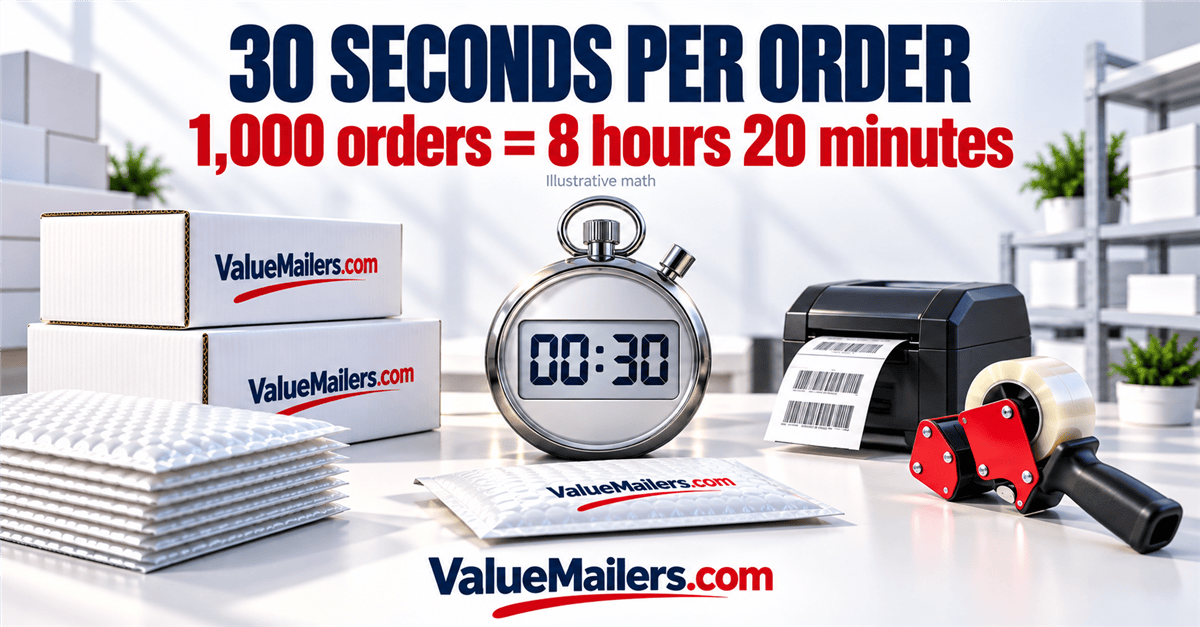
Better packing station efficiency starts with a stopwatch and a simple question: where do the seconds go? Thirty seconds sounds too small to matter. Across 1,000 orders, however, it adds up to 500 minutes, or eight hours and twenty minutes.
This is illustrative math, not a measured savings claim. Your team may find more lost time, less, or none in a given step. First, measure the small delays before buying a faster machine or asking people to work faster.
Measure packing station efficiency without rushing the team
Observe a mix of orders with the team’s knowledge. Include easy orders, orders with several items, and exceptions. Then use the same start and finish points each time. For example, start when the order reaches the bench and finish when the sealed parcel is ready for handoff.
Separate useful work from avoidable delays. Wrapping a fragile product well is useful work. By contrast, hunting for a box because several sizes share one bin may reveal a storage problem.
Record the cause of each delay. Also, ask the person at the bench what slows the process down. The aim is to improve the work setup while keeping checks and protection in place.
Follow one order through the packing bench
Where are the boxes and tape? Does the label printer sit behind the packer? Is the scale blocked by finished parcels? Next, sketch the movement from one step to the next.
Look for repeated reaching, walking, screen changes, and moving stock out of the way. For better packing station efficiency, keep the main work area clear. Then place common supplies where staff can reach them safely. For broader workplace guidance, review OSHA’s warehousing resources.
For example, keep common white corrugated boxes in clearly marked locations. Use each product’s size and strength requirements to choose the right box. A short walk may still be necessary for a less common size.
Keep supplies ready before the next batch
Packing station efficiency also depends on steady supplies. A bench that runs out of labels mid-batch has a different problem from a slow packing method. Therefore, set a simple stock check at useful points in the day. Base bench quantities on actual use and the room available.
Store extra stock separately and label its location. Keep walkways open. Also, place shipping labels where staff can reload the printer without searching.
| Time loss | Small change to evaluate |
|---|---|
| Searching for box sizes | Clearly label storage positions |
| Printing labels again | Check label stock, settings, and print steps |
| Walking for cushioning | Refill a sensible bench quantity |
| Reopening sealed parcels | Check the order before sealing |
| Hunting for instructions | Keep approved packing steps close by |
Turn packing station efficiency into a realistic business case
At 1,000 orders, ten seconds per order equals two hours and forty minutes. Thirty seconds equals eight hours and twenty minutes. Sixty seconds equals sixteen hours and forty minutes.
These totals apply to any period with 1,000 orders. They are not automatically weekly savings. Instead, use your actual order count and the time difference you measure.
Multiplying saved time by a labor rate gives an estimate of the value of that time. It becomes cash savings only if your costs fall. Otherwise, the gain may mean room for more orders or less pressure near the pickup cutoff.
Change one thing, then measure again
Finally, compare similar orders before and after the change. Keep protection and accuracy checks in place. A faster process that causes more damage or mistakes is not an improvement.
Next, write down the new setup so the team can repeat it on a busy day. Review the next delay only after checking the first change. Our guide to comparing three packaging options for one product can help you assess fit, cost, and packing time together.
Start with one station, one clear measurement, and one change. Over time, this packing station efficiency audit can show which improvements help your own operation.
Choose supplies that fit the order and the station
Review white corrugated mailer boxes for compact orders. For larger pack-outs, compare white corrugated shipping boxes. Check each product’s actual size and specifications before setting a standard packing method.
For suitable orders, keep Bubble Mailers in marked bins by size. Meanwhile, Bubble Pouches and Bubble out bags can provide a prepared inner layer. Padded packaging does not replace rigid protection when a fragile product needs it.