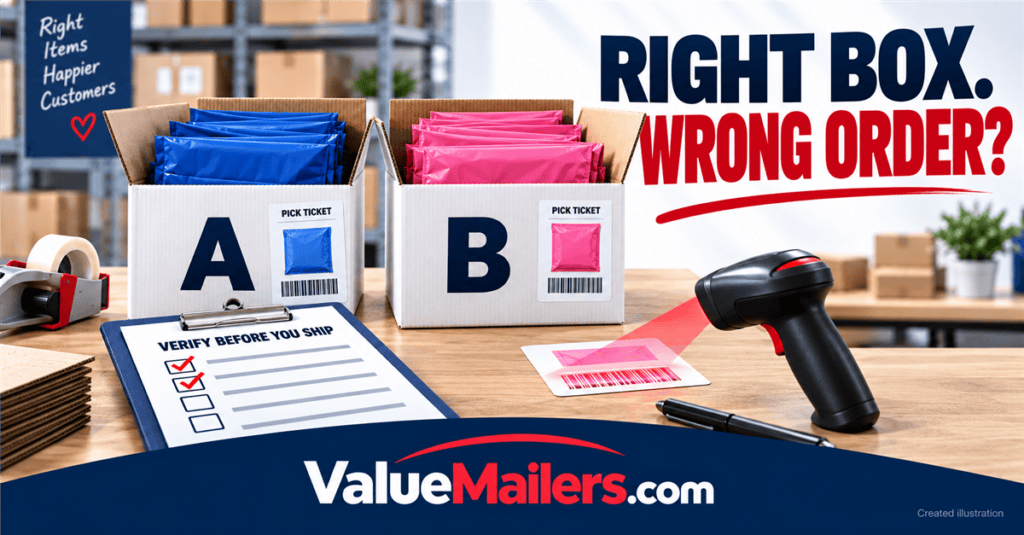
To prevent packing errors, check the SKU, count, and label before sealing each order. The package arrived on time. Nothing was damaged. The customer is still unhappy because the quantity, color, or size is wrong.
Packaging quality cannot rescue an order that contains the wrong item. For businesses with similar-looking products, accuracy needs its own checkpoint before the box is closed.
The most useful question is not “Does this look right?” It is “Does this match the order in the system?”
Prevent packing errors: verify the exact variant
Two packs can look nearly identical while representing different sizes or counts. A shelf label that says only “pink mailers” leaves too much room for interpretation.
First, give each picking location a clear identifier. For example, show the SKU, useful variant details, and units per pack where staff can see them. If a supplier label conflicts with the internal SKU, resolve the mismatch rather than asking people to remember an exception indefinitely.
Next, use a reference photo when it genuinely helps, but do not let a photo replace the written size and quantity.
Make the units explicit
An order quantity of two does not always mean two individual pieces. It might mean two packs of 100.
For an illustrative example, two 100-count packs equal 200 pieces. Show that total clearly in the pick instructions and customer-facing description. If your system tracks packs, do not silently change the inventory unit to individual pieces.
Also, when several sealed packs travel together, the packing note should state both the number of packs and the total contents. Meanwhile, keep customer messages separate from internal handling notes.
Prevent packing errors with a final label check
However, a mixed batch of orders can be correct until the wrong label is applied. Keep each order’s items, paperwork, and shipping label associated throughout packing.
In addition, barcode verification can support this process when you set up your software and product data correctly. However, it cannot correct an inaccurate SKU mapping by itself.
| Checkpoint | What to confirm |
|---|---|
| SKU | Exact item and variant match |
| Unit | Pack, set, case, or individual piece |
| Quantity | Correct number of selling units |
| Notes | Current special instructions reviewed |
| Label | Recipient and order match this parcel |
Create an exception area
To prevent packing errors, keep unclear orders away from finished parcels. Use a designated place for issues such as conflicting counts, missing items, or unusual instructions. Also, record why the order is held and who will resolve it.
For this reason, an exception area should make uncertainty visible, not hide it. Review it before the carrier cutoff so unresolved orders do not disappear into tomorrow’s workload.
If an item description is wrong on a marketplace, correct the source listing through the appropriate process. Repeated manual notes are not a durable substitute for accurate catalog data.
Measure errors without blaming the packer
Track the type of mismatch: wrong variant, wrong count, missing item, or label swap. Also record where the confusion began. A packing mistake may originate in a listing, shelf label, purchase order, or software mapping.
Then compare the same categories over time. Do not treat a few error-free days as proof that you have solved the problem.
Finally, start with your most confusing product family. Improve its labels, instructions, and release check. Then extend the approach to other products.
These checks help prevent packing errors at their source. The best-packed order is not merely secure. It contains exactly what the customer bought.
Use our shipping label checklist for the final release check. Also, try a packing-station time audit to spot delays without skipping accuracy checks.
Explore suitable packing supplies
Compare white corrugated boxes for your product size and load. For compact presentations, review white corrugated mailer boxes; for outer packaging, review white corrugated shipping boxes. Above all, check each product’s actual specifications.
Browse Bubble Mailers, Bubble Pouches, and Bubble out bags for appropriate applications. Padded packaging is not a substitute for the rigid protection a fragile item may require.