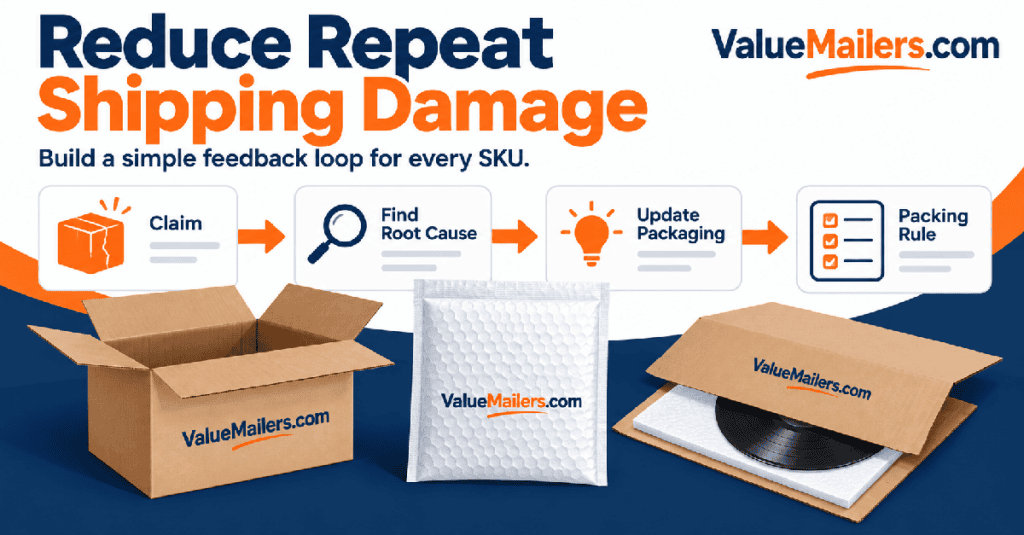
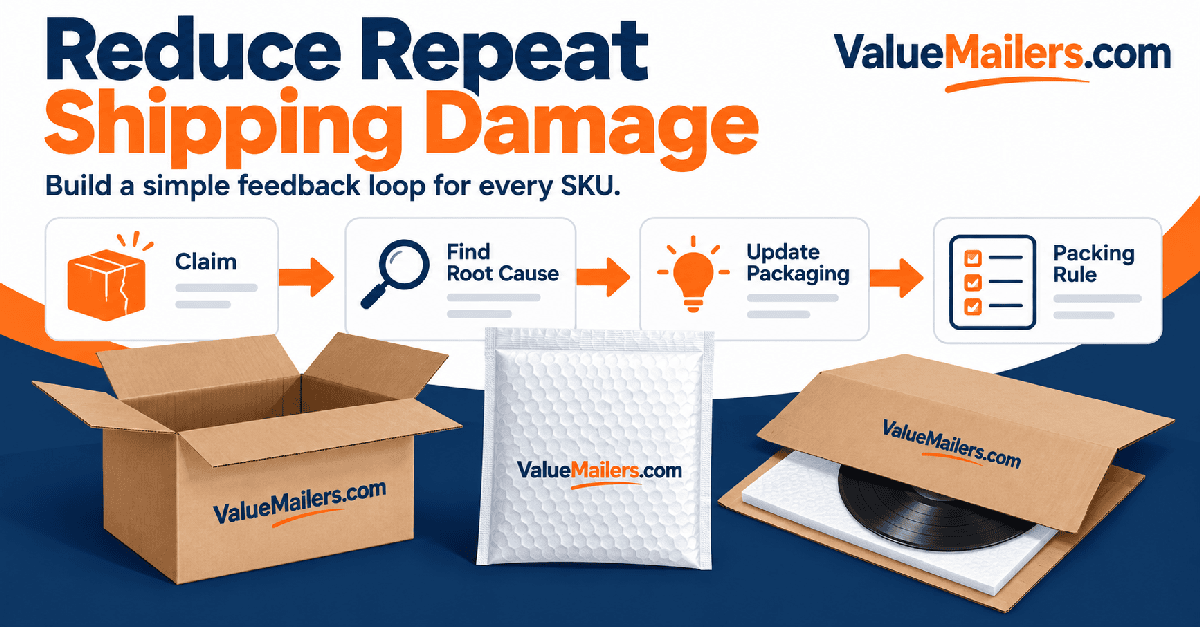
Shipping damage claims are frustrating, but they can also show where a packing process needs attention. The useful response is not to change every package after one complaint. It is to collect the right details, sort the failure pattern, and update one clear packing rule for the next order.
This guide gives ecommerce sellers a practical feedback loop: spot the damage, sort the cause, improve the pack-out, and verify the new rule. It helps protect profit without turning every shipment into an overpacked box.
Start with the package that actually failed
First, keep the damaged product and all packaging for the claim review. If the sender files a USPS damage claim while the recipient has the parcel, USPS requires the recipient to retain the item and packaging until resolution. Follow any inspection request. Check the applicable carrier’s instructions for your shipment.
Also, use our shipping damage photo checklist to capture useful views. Good photos help you review shipping damage claims without guessing what happened inside the box.
For each claim, record these details:
- Order number, SKU, and damage type.
- Outer package type and dimensions.
- Inner protection, fill, inserts, and closure.
- Packed weight, destination, and photos.
- Earlier failures with the same product and package.
One isolated incident may not justify a new box size. In contrast, a repeating pattern does. However, a serious failure deserves prompt review.
Sort shipping damage claims before buying more material
The right correction depends on what failed. Adding more fill to every box can raise labor and postage without fixing the underlying issue.
| What you see | Likely packing question | First improvement to test |
|---|---|---|
| Item shifts or rattles | Is the outer package too large? | Use a closer-fitting package, then add only enough cushioning to stop movement. |
| Corners crush or flat items bend | Does the order need structure rather than soft cushioning? | Try a right-sized corrugated package or rigid pads. |
| Seal opens | Was the closure clean and fully adhered? | Standardize the closure step and inspect before labeling. |
| Scuffs or surface marks | Did the product rub against another item or the package? | Separate contact surfaces and stabilize the item. |
Use the smallest safe package
A large box can let a product build momentum and strike a wall. A package that is too tight can transmit pressure into corners or fragile parts. The aim is a stable, protected order that closes normally.
For soft goods with low crush risk, a poly mailer may keep the shipment compact. Small hard goods that need light cushioning may suit Bubble Mailers. However, fragile or crush-sensitive items usually need the structure of white corrugated boxes. Choose based on the product, its finish, and how it could move inside the package.
For compact orders, compare white corrugated mailer boxes with the wrapped product. For larger packs, choose white corrugated shipping boxes that leave room for suitable cushioning. Meanwhile, Bubble Pouches can separate small items and reduce contact. Use Bubble out bags as inner cushioning where appropriate, not as a substitute for a rigid outer box.
Turn shipping damage claims into a one-line packing rule
After reviewing a pattern, make the correction easy for the next packer to repeat. Avoid “pack better.” Write a short rule tied to the SKU or product family.
A good rule is: “For SKU A, use the small carton; center the wrapped item; add side cushioning until it does not shift; seal the center seam; apply the label to the largest flat panel.” It tells the packer what to grab and what a finished pack-out should look like.
| Order type | Repeatable rule | Final check |
|---|---|---|
| Flexible apparel | Use the smallest poly mailer that closes without stretching. | No rigid part can press through the mailer. |
| Small padded item | Use a bubble mailer sized so the item stays centered. | Edges are protected; item does not slide to a corner. |
| Vinyl or flat collectible | Use a fitted record mailer and pads when added stiffness is needed. | Corners clear fold lines; mailer closes without forcing. |
For flat vinyl orders, LP record mailers give the shipment a controlled outer structure. Use pads when that particular order needs more stiffness; one setup does not fit every jacket, gatefold, or bundle.
Protect the label step, too
A well-packed package can still create an exception if the label wrinkles over a seam, folds around an edge, or covers an opening. Therefore, make the final rule simple: apply shipping labels to a clean, flat panel and inspect the barcode area before the order leaves the station.
Verify one change before rolling it out
Test one change at a time when practical. For example, keep the product and closure method the same while trying a closer-fitting box. Next, inspect several completed orders. Then compare later shipping damage claims for that SKU. For higher-risk products, consider professional pre-shipment testing. ISTA explains that the shipper and relevant stakeholders should agree on damage and package-condition criteria before judging results.
Track claims by SKU and package type, along with the number of comparable shipments. Compare claim rates, not just claim counts. Also note the failure mode, packing time, shipping charges, and customer feedback. If the trial shows a better result, keep the rule and continue to monitor it. If failures continue, return to the evidence and test the next likely cause.
Shipping damage claims: a five-minute review checklist
- Save photos of the product, inner packaging, and outer package.
- Identify the SKU, package size, materials, closure, and destination.
- Classify movement, compression, edge damage, surface damage, seal failure, or label issue.
- Pick one correction that matches the evidence.
- Write it as a one-line packing rule and test it on comparable orders.
- Review the result before changing the rule again.
Shipping damage claims: frequently asked questions
Should every damaged order mean using a larger box?
No. A larger box can create more movement. Find out whether the issue was fit, structure, internal movement, closure, or product-to-product contact, then choose the smallest protective package.
How many claims justify a packaging change?
There is no universal threshold. A severe failure may need immediate review; a less serious issue may need a repeated pattern. Record the SKU, failure type, and existing pack-out so the decision is based on evidence.
What should a packing rule include?
Name the package, protection or insert, item position, closure, and final label check. Keep it short enough to use at the station.
When should I use a record mailer instead of a regular box?
Use a fitted record mailer for record-sized flat orders that fit its dimensions and closing depth. Move to a right-sized corrugated carton when the protected stack is too deep, includes mixed items, or needs more stabilization.
Make the next shipment easier to pack correctly
Ultimately, shipping damage claims can guide better choices, not just more packaging. It is the one that turns a real failure into a simple, visible, repeatable packing rule. Start with the package that failed, correct the specific cause, and make the safe choice easy for every future order.