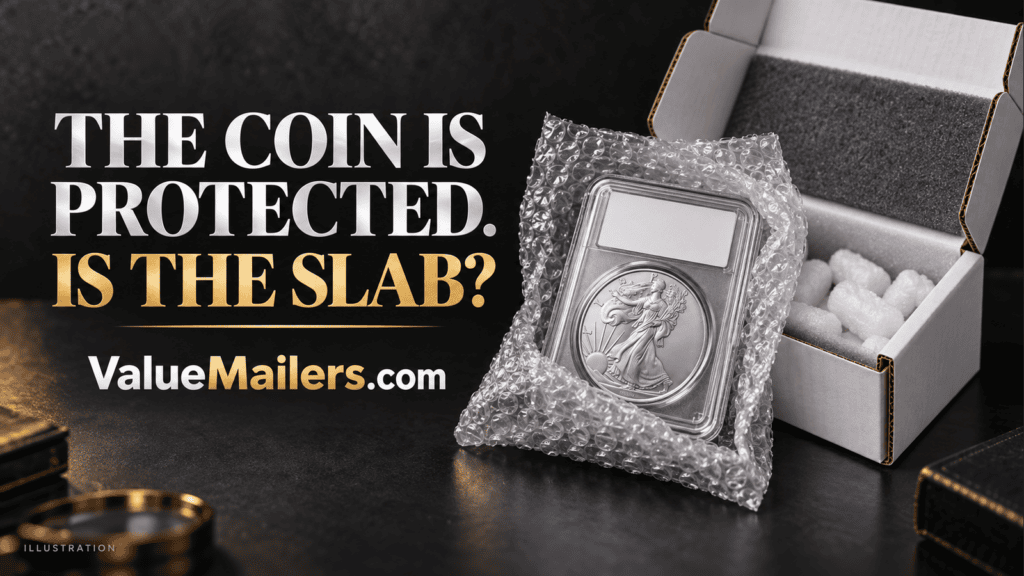
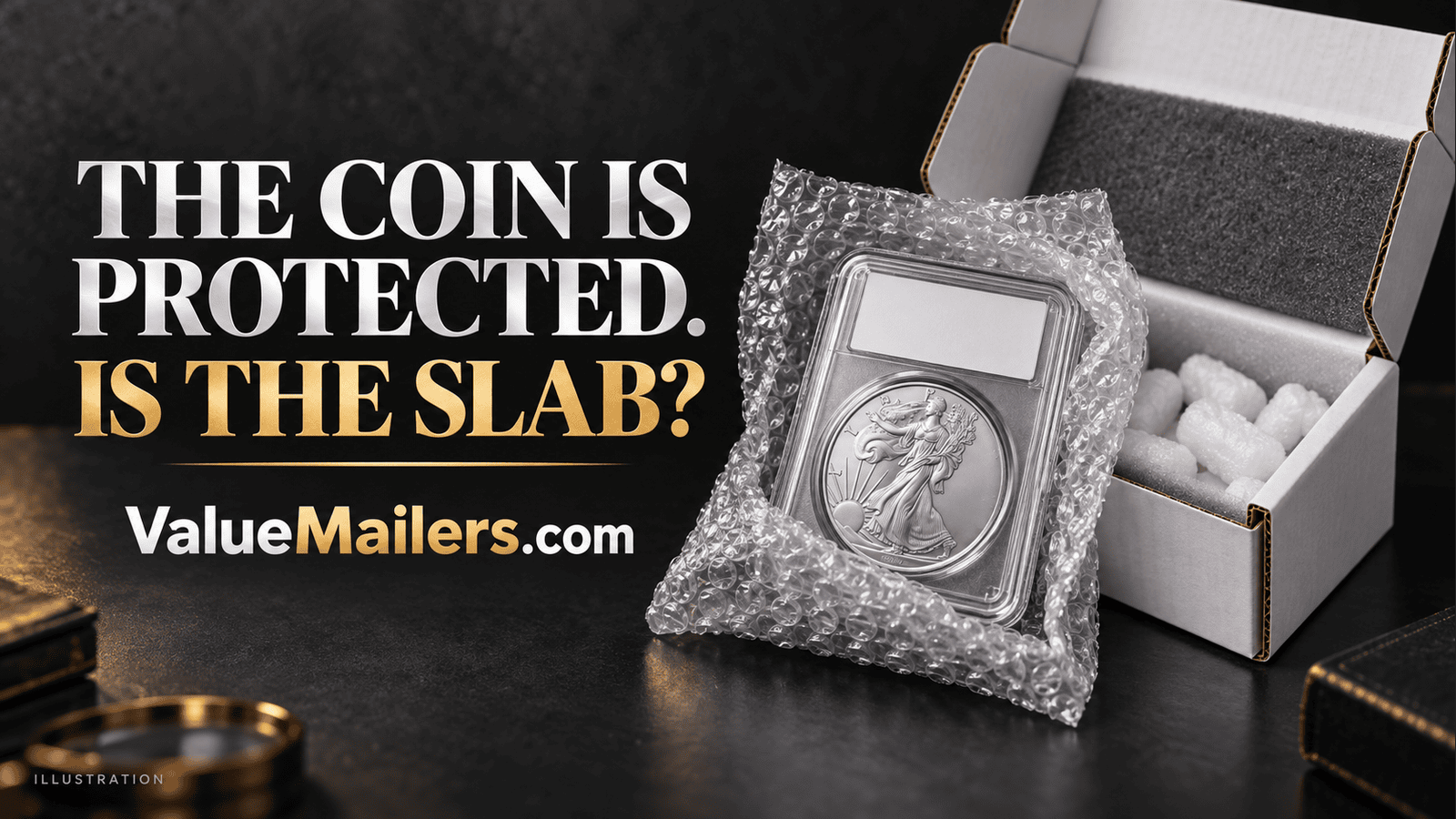
Shipping graded coins takes more than placing a hard plastic holder in a padded envelope. Keep the coin sealed in its holder, protect the slab’s surfaces, cushion it individually, and secure it inside a correctly sized corrugated box. Then confirm the shipping service and coverage apply to the actual contents.
The coin may arrive inside its holder, yet the buyer can still receive a scratched case, a damaged corner, or an order that does not match the listing. For a collectible seller, the holder deserves its own packing plan.
Why the slab needs a separate protection plan
A grading holder is not an outer shipping container. It still has broad faces, projecting edges, and a label area that buyers need to inspect. Adding soft material does not automatically prevent the holder from shifting or pressing against a box wall.
Think in three layers: the sealed holder protects the coin, an individual sleeve and cushioning protect the holder, and the outer box contains the packed order. Each layer has a different job. More wrapping is not necessarily better if it makes the box hard to close.
Shipping graded coins starts with the right item
Before wrapping, match the order to the slab. Check the denomination, date, mintmark where relevant, grading-company name, grade, and certification number against the listing. For two similar coins, use the identifier rather than appearance alone.
Photograph the front and back of the holder, including visible marks and its label. Keep those images with the order record. Photos are useful documentation, but they do not authenticate a coin, guarantee coverage, or decide a buyer dispute.
Do not open a sealed grading holder to improve the presentation. If the case has damage that needs attention, consult the grading company’s current holder-service guidance. Keep repair or replacement decisions separate from routine fulfillment.
Protect the faces without taping the slab
Use a clean sleeve suitable for the holder, then add contained cushioning around it. Avoid abrasive packing surfaces, staples near the case, and adhesive directly on the slab or certification label. Tape should secure the packing material, not become something the buyer must scrape off the holder.
Bubble Pouches can keep cushioning around one sleeved slab while you prepare the box. Choose by the wrapped holder’s dimensions, not the coin’s diameter. The slab should slide in without being forced.
For a multi-item station, keep several sizes of Bubble Out Bags available. Oversized, folded material can create uneven pressure or conceal the order identifier. Check the fit before you standardize a pouch size.
Shipping graded coins: choose the right box
Measure the slab after adding its sleeve and cushioning. Allow room for protection on every side, but avoid a large empty cavity. The closed flaps should not press on the holder, and the wrapped slab should not sit directly against an unprotected outer wall.
Compare White Corrugated Boxes by dimensions, construction, and the packed order’s weight. White is a presentation choice, not a strength rating. Check the specific box’s suitability rather than relying on its color.
Close-fitting White Corrugated Mailer Boxes are worth considering for compact orders. For bulkier collections or an inner-box arrangement, review appropriately sized White Corrugated Shipping Boxes. A larger carton still needs a plan to keep the inner package in place.
NGC’s current submission instructions call for an appropriately sized, well-secured box and recommend a box within a box. Those instructions apply to NGC submissions; check the recipient’s requirements instead of treating them as a universal shipping standard.
A packing decision for each order type
| Order | Packing decision | Final check |
|---|---|---|
| One standard slab | Individual surface protection and cushioning in a snug box | No pressure from the closed lid |
| Several slabs | Separate protected slabs with stable packing zones or dividers | No holder-to-holder contact or shifting |
| Oversize holder or presentation case | Measure the complete protected item before choosing the carton | No forced fit or unsupported protrusions |
| Grading-company submission | Follow the recipient’s current packing and paperwork instructions | Correct form, item identifiers, and required exterior markings |
Separate slabs before they become a moving stack
When shipping graded coins together, do not treat several holders as one loose bundle. Protect each slab, then use stable dividers or individual packing zones to keep the hard cases apart. Confirm that the separation remains effective when the box is upright, sideways, and closed.
Keep loose accessories and paperwork from becoming pressure points. Put the order list where it is easy to find, without covering a slab’s label with adhesive. For similar items, a numbered packing list can make the contents easier to check.
Can you use a bubble mailer for graded coins?
For this slab-focused workflow, start with a box. Bubble Mailers provide cushioning, but a padded exterior alone is not a substitute for the rigid support and controlled fit described here. A holder fitting inside a mailer does not establish that the complete package is suitable.
Service rules matter, too. The USPS Domestic Mail Manual’s Registered Mail section does not permit padded envelopes, plastic mailers, or certain other outer materials for that service. Follow the current sealing and packaging requirements before choosing supplies.
Gold and silver coins: check coverage separately
A graded gold or silver coin needs both a packing plan and a service check. Confirm whether the chosen carrier and any insurer accept the exact item, how value is established, which exclusions apply, and what documentation and delivery options they require.
Do not assume tracking, a signature, or entering a declared value guarantees reimbursement. Keep required declarations accurate. Avoid unnecessary promotional descriptions on the outer parcel, but never omit information the carrier, recipient, insurer, or customs authority requires.
The final graded-coin shipping checklist
- Match every slab’s certification details to the order.
- Record the holder’s visible condition before packing.
- Keep the slab sealed and adhesive away from its surfaces.
- Protect and cushion each holder individually.
- Separate multiple slabs and secure the packed contents.
- Close the box without pressing on the holder.
- Gently check for movement; reopen and correct loose contents.
- Confirm service eligibility, coverage terms, paperwork, and labeling.
A gentle movement check can reveal a packing problem. It is not a certified transit test or proof against damage. Evaluate the complete packing arrangement before using it for a valuable shipment or a repeat production workflow.
Keep your collectible packing station item-specific
For loose coins, capsules, rolls, and other formats, see our broader coin-shipping guide. Keep the slab workflow separate so staff do not substitute a thin-holder method for a bulky graded case.
If you also sell vinyl, keep Record Mailers for record-sized orders rather than using them as oversized coin boxes. The same principle applies across collectibles: choose packaging around the finished protected item, not whichever empty mailer is closest.
When shipping graded coins, protect what the buyer will inspect: the coin, the holder, its identification, and the complete order. Explore ValueMailers’ pouches and corrugated boxes, check their fit, and build a repeatable packing standard around your actual shipments.