
A reliable coin order packing routine matches every physical piece to the order, contains each group, and checks the total again before sealing. Halloween is a good time to remember the real packing-station scare: a carefully protected parcel that arrives one coin short.
Imagine a customer buying twelve collectible coins. Eleven arrive in excellent condition. The empty space is still a problem. This is a hypothetical example, not a customer incident or a measured test. It shows why order accuracy deserves its own checklist.
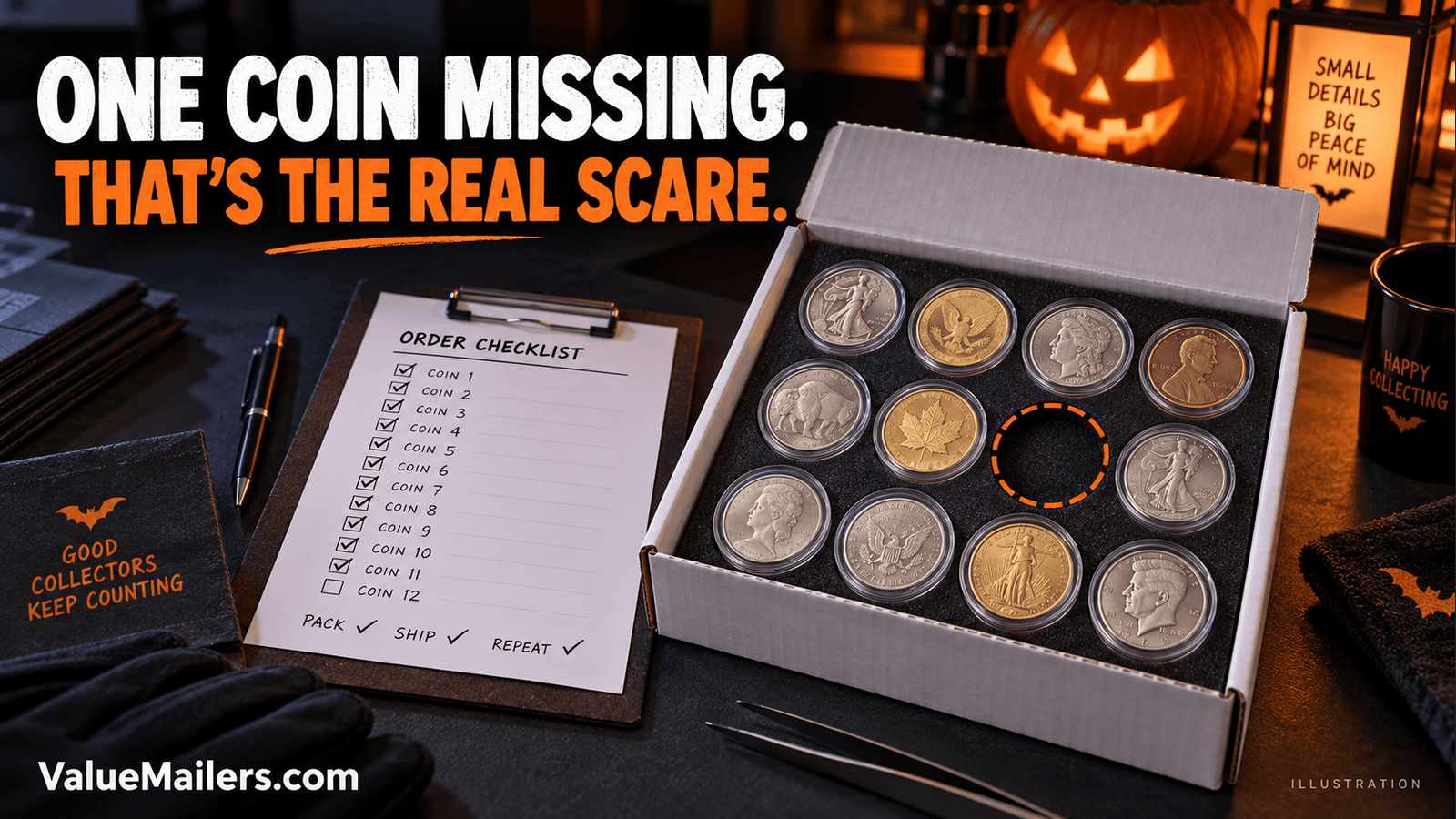
Make the packing station less haunted
Halloween decorations can stay festive without turning the workbench into a scavenger hunt. Keep loose confetti, candy, and decorative fillers away from the area where coins are counted. A small missing item should not disappear beneath seasonal tissue.
Set up three distinct spaces: items waiting for verification, items checked against the order, and the finished package. Work on one customer’s order at a time. If someone interrupts the process, leave a clear note about the last completed check rather than relying on memory.
A decorated workstation is optional. A repeatable workflow is not. Give each order its own tray, paperwork, or clearly identified container so two similar purchases cannot drift together.
Start coin order packing with identity, not just quantity
Twelve coins counted correctly can still be twelve wrong coins. Start with the order’s line items, then compare the physical contents. Check the denomination, date, mint mark, variety, and other details that the actual listing identifies. For certified coins, match the stated certification details too.
Do not add attributes that were not promised. An order for a particular year and mint mark needs that specific match; a mixed lot needs the contents and quantity described in its listing. Follow the sale description rather than guessing what the buyer expects.
Keep original cases and accompanying documentation with the appropriate items. The U.S. Mint’s coin-care guidance discusses original packaging, suitable holders, and saving certificates or information cards. Counting is not a reason to disturb a sealed holder or remove a coin from its protective case.
Count pieces, containers, and line items separately
A single order line may represent several coins. One tube may contain more than one piece. One presentation set may include coins plus a certificate. Write down what each number represents so a container count cannot masquerade as a coin count.
For example, a hypothetical order could contain four individual coins, three coins in a set, and five coins in another group. The piece total is twelve, but the packing groups may number only six if each individual coin is separate. The exact arrangement depends on the holders and order description.
Record both the expected piece total and the grouped contents. A sealed tube’s capacity, a stack’s height, or the weight of a parcel is not a substitute for verifying what was actually packed. Do not open sealed retail or certified packaging merely to recount it.
| Order type | What to verify | What can go missing |
|---|---|---|
| Several individual coins | Each listing identity and the total number of pieces | A similar-looking coin left in the unchecked area |
| A coin set with documents | The described coins, case, and included paperwork | A certificate or information card separated from its set |
| A mixed multi-line order | Each line’s quantity, each group’s contents, and the full order total | A whole packet mistaken for one already checked |
Contain checked groups so the count stays useful
Once a group is verified, keep it together in a suitable arrangement. Label the outside of its protective container or add a separate paper identifier. Never stick a label to a coin surface. Avoid covering information needed for the final order check.
Use coin-safe holders as the contact layer. The U.S. Mint recommends acid-free cardboard and PVC-free plastic holders because inappropriate materials can harm coin surfaces. Ordinary shipping cushioning is not a claim of archival storage suitability.
Bubble Pouches can provide an outer cushioning layer around appropriately held items. Check the fit before closing: the pouch should not force a container shut or hide an unchecked item. Keep the identifier readable until the group is reconciled.
For a separately verified bundle, appropriately sized Bubble Out Bags may help keep the cushioning and contents together. They do not confirm the coin count. That still comes from your order record and physical checks.
Choose packaging around the complete order
Plan the package after the complete, protected order is assembled. White Corrugated Boxes offer a structured outer format for grouped contents, but box color is not a strength rating. Choose the actual size, construction, and cushioning for the finished shipment.
White Corrugated Mailer Boxes can suit compact protected orders when the fit and construction are appropriate. Larger or heavier grouped orders may call for White Corrugated Shipping Boxes. Neither name guarantees suitability for every coin shipment.
Do not choose Bubble Mailers solely because the coins look small. Several dense items, bulky sets, or mixed containers may need a box. Check the selected shipping service’s current acceptance and packaging rules for the actual contents, especially gold or silver coins.
Reconcile the order before the Halloween reveal
The last coin order packing check should use the actual order record. Compare every checked group with its line item. Reconcile the expected total, confirm any included documents, and inspect the unchecked area before the package is sealed.
If another team member can review the order, give them the order record rather than only your tally. If you work alone, make a separate final pass from the record to the contents. A quick photograph can support your internal documentation, but it does not authenticate coins, prove a sealed parcel’s contents, or guarantee a claim outcome.
Add a readable packing list that explains the grouped contents without unnecessary sensitive information. American Gold Exchange’s receiving instructions include an inventory list for shipments to that dealer. Your customer’s requirements may differ; the useful principle is to make the contents understandable.
Keep the Halloween flourish outside the functional count. One seasonal card or an exterior sticker can set the mood without burying small packets. A card should never imply that a commemorative theme changes a coin’s authenticity or value.
Your final coin order packing checklist
- One customer’s order occupies the packing area.
- Each item matches the listing details that were sold.
- Piece counts and container counts are recorded separately.
- Sets retain their described cases and included documentation.
- Verified groups stay contained and identifiable.
- The full order is reconciled before cushioning hides the contents.
- The package fits the complete protected order and the chosen service.
- The shipping label belongs to this order, not the next one.
Coin order packing questions sellers ask
Should I open a sealed coin set to count the pieces?
No. Preserve sealed packaging and check its identity against the sale description. If something does not match, pause fulfillment and resolve the discrepancy before shipping.
Can I use package weight to prove every coin is included?
No. Weight can be an additional internal check, but holders, documents, and cushioning affect it. It cannot replace an item-by-item reconciliation.
Can I add Halloween candy to a collectible coin order?
A simple seasonal card is easier to keep separate from the contents. Avoid adding food that could leak, leave residue, or create confusion about what the order includes.
Is this the same as a guide to protecting graded slabs?
No. This guide focuses on accurate, complete multi-coin orders. For holder protection, see our separate shipping graded coins guide. For a broader packaging overview, see how to ship coins safely.
No tricks. No missing pieces. Let the Halloween surprise be the presentation, not an incomplete order. Count, identify, contain, and reconcile—then seal the box.