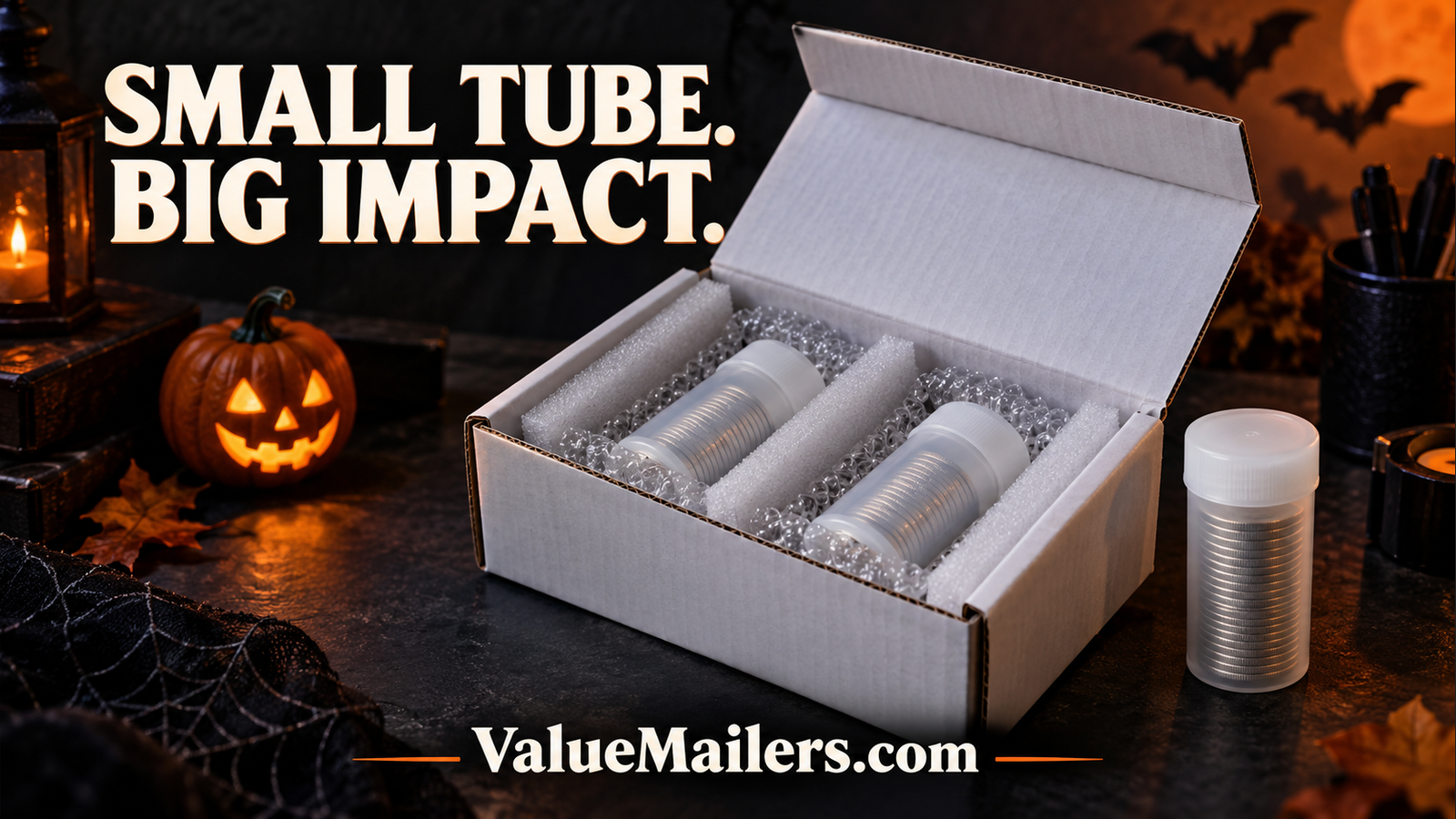
Shipping coin tubes starts with controlling a compact, heavy object: check the holder and lid, cushion each closed tube separately, and use an outer box that keeps the load stable. A small parcel can carry substantial weight. Its size alone tells you little about the protection inside.
Your Halloween promotion might feature silver rounds, gold coins, or a collector’s seasonal purchase. The packing problem is the same: a tube that slides across the carton can strike a wall, another tube, or a presentation case. Treat that movement as a packing problem before it becomes a customer’s surprise.
Before shipping coin tubes, check the holder
Begin with the tube supplied or approved for those coins. Check its size, condition, and closing method. A cracked wall, worn cap, or poorly fitting lid needs attention before you add outer cushioning. Preserve original packaging when it forms part of the product the buyer purchased.
A partly filled tube needs a holder-specific solution for internal movement. Ask the tube supplier or coin specialist what is appropriate. Do not stuff household filler against the coins or force a lid down over an overfilled stack. Packing material around a tube cannot repair an unsuitable holder inside it.
The U.S. Mint’s coin-care guide recommends suitable holders and warns about acid and PVC in materials that contact coins. Keep outer shipping cushioning outside the closed coin holder. A bubble pouch is an outer packing layer; it is not a substitute for a suitable coin-storage container.
Keep the lid secure without damaging the product
Inspect the closed cap and follow the holder manufacturer’s instructions for any added securement. Consider how the buyer will remove it. Keep adhesives away from coin surfaces, certificates, and collectible packaging. Do not assume every lid, finish, or branded tube tolerates the same tape.
If the tube needs another containing layer, choose one that fits the closed holder. Include simple opening instructions when securement is not obvious. The buyer should be able to release the packing without pulling on a fragile part or spilling the contents.
For a partial tube or an unusual holder, pause and resolve the fit. Opening a sealed collector product or changing its contents can alter what you are selling. Match the package to the actual order rather than modifying the product for convenience.
Shipping coin tubes requires separation and restraint
Cushion each closed tube individually. Then place it in a fitted area that limits sliding, rolling, and end-to-end movement. Keep tubes apart so their hard surfaces cannot collide. Plan protection below and around the load, as well as above it when the box closes.
Use Bubble Pouches when their dimensions suit the protected holder. Bubble Out Bags can help contain that cushioning during assembly. However, cushioning and a stable compartment perform different jobs: wrapping alone may leave a tube free to move inside a large carton.
For several tubes, consider a suitable divider or fitted insert with support beneath each compartment. Check the complete arrangement in different orientations. If the design works only while the parcel stays upright, revise it. Do not leave a heavy tube resting against an unprotected box wall or a delicate presentation case.
Choose the outer box for the packed weight
Start with the dimensions of the protected tubes, not the bare holders. Compare White Corrugated Boxes by their actual specifications. The product name and color do not establish a weight rating or prove that a carton suits dense contents.
A compact order may fit White Corrugated Mailer Boxes with an appropriate internal arrangement. For a heavier or larger order, review White Corrugated Shipping Boxes and confirm the carton specifications with the supplier. Measure and weigh the finished parcel before buying postage.
| Order format | Plan around | Check before sealing |
|---|---|---|
| One full tube | Lid integrity, cushioning, and restraint in every direction | The tube cannot slide toward a carton wall |
| Several tubes | Separate stable compartments and support below the load | No tube-to-tube contact or divider movement |
| Partial tube | The holder supplier’s solution for movement inside the tube | No improvised filler touches the coins |
| Tube plus presentation case | Separate packing zones for dense and delicate items | The tube cannot strike or press on the case |
Bubble Mailers can suit some lightweight supporting items, but they do not create a rigid compartment for a dense tube. Likewise, Record Mailers serve flat media; a close-looking fit does not make them the right container for coin tubes. Choose packaging for the load it must hold.
Finish the Halloween order with a repeatable check
Keep loose confetti, glitter, and decorative filler outside the protective system. A seasonal card can add personality without changing the tube’s support. Put paperwork in its own clean area so a dense item cannot crease it. Avoid exterior descriptions that unnecessarily advertise valuable contents.
Before shipping coin tubes, gently check the closed parcel for obvious movement and inspect the seams. This is a basic assembly check, not proof of transit performance. For recurring orders, document the exact carton, insert, cushioning, packed weight, and tube arrangement so the next packer can repeat the approved setup.
- Confirm the correct holder and intact lid.
- Resolve movement inside a partial tube using suitable guidance.
- Cushion closed tubes separately and keep them apart.
- Match carton specifications to the complete load.
- Check stability, closure, final dimensions, and weight.
- Confirm carrier acceptance and coverage terms for the actual contents.
Review the selected service’s current terms before relying on coverage for coins or precious metals. The USPS insurance and extra-services information explains available options and points to applicable conditions. A purchased label or a declared amount alone does not establish what a particular loss would cover.
For other order formats, see our general coin-shipping guide and graded-coin packing guide. This article focuses on closed tubes and dense loads, rather than slab protection or order counting.
Questions coin dealers ask about shipping coin tubes
Can I put two wrapped tubes next to each other?
Only if the complete arrangement keeps them separated and stable. Check whether the protective layers remain in place and whether the tubes can move together when the parcel changes orientation. Add appropriate compartments when wrapping does not control that movement.
Should I fill empty space inside the coin tube?
Use guidance for that particular holder and coin format. Random padding may introduce unsuitable contact materials or pressure. Resolve the holder’s internal fit before designing the outer shipping package.
Does more tape make a light carton suitable for a heavy order?
Tape closes and secures seams; it does not establish a new carton weight rating. Choose a suitable carton and internal support first, then close it according to the carton and carrier requirements.