Your packing-and-shipping cost per order includes more than a box and a postage label. Add the materials you use, the time spent fulfilling the order, carrier charges, and additional damage-related costs. Then show any allocated fulfillment overhead separately.
This worksheet helps you find costs missing from a quick estimate. It is not a complete profit calculation: the normal cost of the merchandise, selling fees, advertising, and other business expenses still matter.
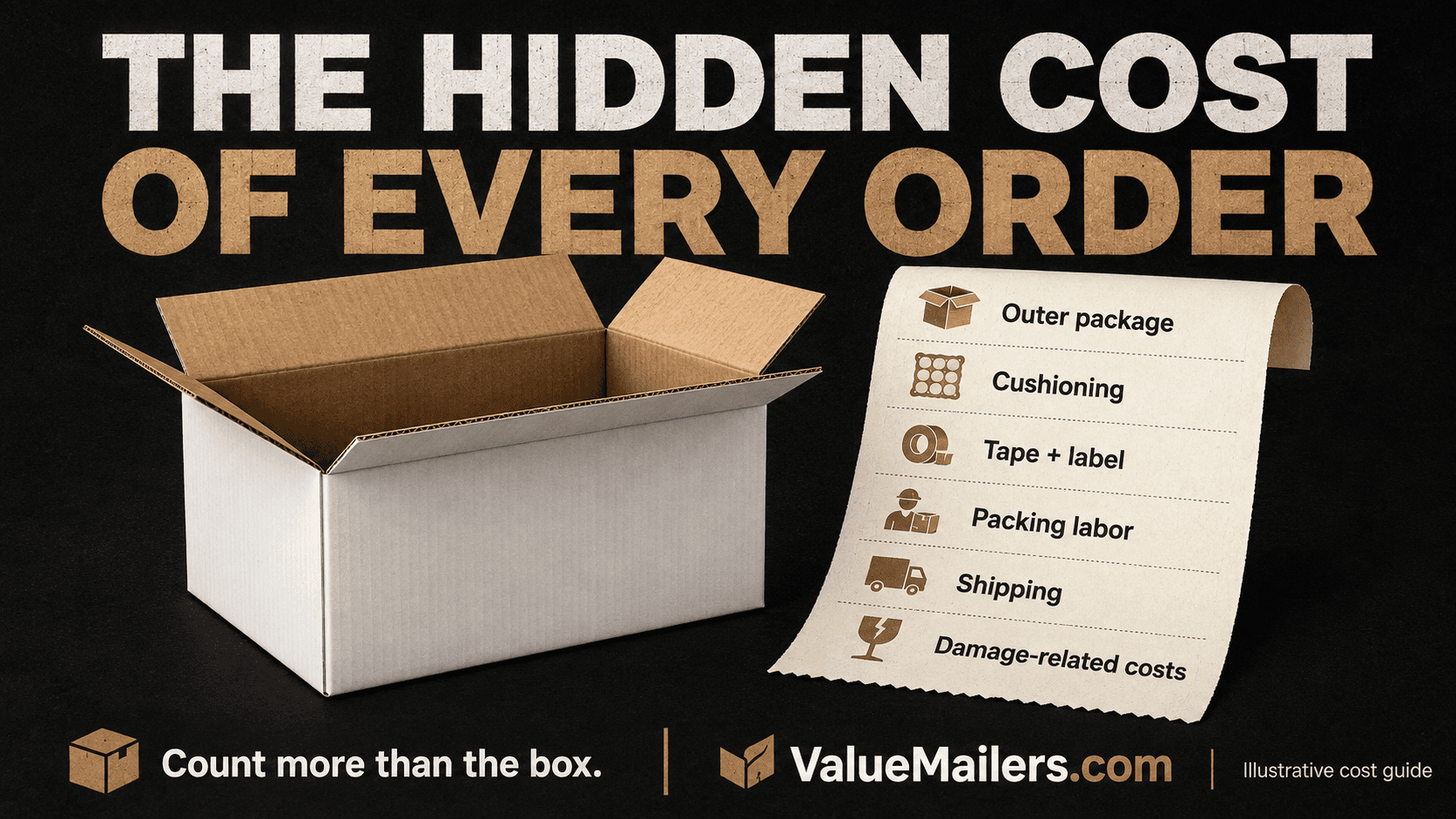
What belongs in your cost per order?
Start by writing down the boundary of the calculation. Here, we are measuring the cost to prepare and send customer orders, plus a clearly defined allowance for damage-related work and fulfillment overhead.
Broader fulfillment can also include receiving and storage, as Shopify’s fulfillment-cost overview explains. If those activities matter to your decision, add them consistently. Do not compare a packing-only estimate with a provider’s wider service bundle.
| Cost line | What to include | Where to find it |
|---|---|---|
| Outer package | Every box or mailer used, including a second parcel for a split order | Supply invoices and actual pack quantities |
| Cushioning and separation | Wrap, paper, pouches, pads, or dividers used for this order | Supply cost per usable unit × units used |
| Tape, labels, and inserts | Sealing materials, physical label stock, and any included insert | Actual consumption; keep label stock separate from postage |
| Direct labor | Picking, assembly, wrapping, sealing, labeling, and normal rework within your defined scope | Time sample × employer cost per hour |
| Carrier charges | All original outbound parcels plus applicable billed adjustments | Final carrier or shipping-platform billing records |
| Damage-related costs | Additional costs of handling damage and sending replacements, net of confirmed recoveries | A matched shipment group and incident log |
| Allocated fulfillment overhead | A stated share of packing space, equipment, systems, or other fulfillment costs not counted above | Documented allocation using the same reporting period |
Use one row per cost in your own worksheet. Beside every amount, record its source and date. Mark an estimate as an estimate; an empty cell should not quietly become zero.
Count orders and parcels separately
A customer order can leave in two boxes. In that case, include both boxes, both sets of materials, and both original outbound shipping charges in that order’s cost.
For a period average, divide costs for a defined group of customer orders by the number of those orders. Do not divide by parcels and label the result “per order.” Likewise, a replacement parcel is not a new customer sale.
Build materials cost from what you actually use
The price per case is not the cost of packing one order. Divide the supply purchase cost by the usable quantity, then multiply by the quantity consumed. Include delivery charges paid to acquire supplies where relevant, using a consistent allocation.
For example, an insert used in every order belongs in every order’s materials cost. Tissue added only to gift orders belongs in that order group. Track damaged supplies and routine waste too, without adding the same waste twice.
Choose the protective system before comparing prices. For rigid outer packaging, start with suitable White Corrugated Boxes. Compact orders may use White Corrugated Mailer Boxes, while larger or mixed orders may need appropriate White Corrugated Shipping Boxes. Color alone does not establish strength.
For durable items that need padding but not rigid walls, evaluate Bubble Mailers. If a boxed order needs individual cushioning, count each of the Bubble Pouches used. Bubble Out Bags may serve that inner-protection role; they do not automatically replace a suitable outer shipping package.
Finally, include the Packing Tape and Shipping Labels consumed. A physical label’s material cost and the carrier charge purchased through shipping software are two different costs.
Turn packing time into cost per order
Use a consistent start and finish. You might time from picking the items to having the sealed, labeled parcel ready for dispatch. Include assembly, wrapping, checking, and normal rework within that boundary.
Labor cost per order = minutes per order ÷ 60 × hourly labor cost.
Use your employer cost, not just the employee’s base wage, when those additional costs apply. The Bureau of Labor Statistics distinguishes wages and salaries from total compensation, which also includes benefits. Use your own figures rather than a national average.
If the owner does the packing without drawing hourly pay, show a separate planning allowance for that time. It is not an actual payroll expense. Keeping cash outlay and owner-time estimates visible makes the result easier to use.
For shared batch tasks, allocate the batch time across the orders it serves. Do not charge the full batch setup time to each order. Also, avoid charging wages once through timed labor and again through an overhead total that includes the same wages.
Check the final shipping bill, not only the quote
Record all original outbound parcels and any applicable adjustments. UPS explains that inaccurate shipment details can lead to correction charges after delivery. Therefore, reconcile your estimate with the final billing record when it becomes available.
Measure the finished parcel, not the empty box. Our shipping box costs comparison explains why exterior dimensions can change calculated billable weight. It does not mean a lower billable weight produces the same percentage reduction in postage.
Compare similar order groups: product type, destination, service, and parcel count can all affect the result. An overall average is useful, but it can hide a costly product or a frequent two-parcel order.
Add damage-related costs without counting twice
Keep an incident log linked to the original customer order. For a replacement, record the additional product cost, packaging, labor, and reshipping charge actually incurred. Count replacement merchandise at its cost—not its retail price.
Subtract confirmed recoveries once. Do not assume that an open carrier claim will be paid. If you already included replacement shipping in your carrier total, do not also add it in full on the damage row.
For this worksheet, the normal merchandise cost is outside the scope; additional replacement merchandise is part of the damage-related line. Refunds belong in your wider revenue-and-margin reconciliation. Do not automatically add a full refund and a full replacement to every incident.
Average additional damage-related cost = net additional costs for a defined shipment group ÷ customer orders in that group.
For example, an assumed $150 of additional damage-related costs across 500 orders gives $0.30 per order. This is arithmetic, not a measured damage rate or a prediction. Allow enough time for incidents to emerge, and revisit incomplete records.
A worked cost-per-order example
Every number below is assumed for illustration. These are not ValueMailers prices, carrier quotes, measured packing times, or an industry benchmark. Replace them with your own records.
| Cost line | Assumed amount per order |
|---|---|
| Outer box | $0.60 |
| Cushioning | $0.18 |
| Tape | $0.06 |
| Physical label stock | $0.04 |
| Insert | $0.12 |
| Direct labor: 3 minutes at $24/hour | $1.20 |
| Original outbound carrier charge | $6.80 |
| Average additional damage-related cost | $0.30 |
| Subtotal before allocated overhead | $9.30 |
| Allocated fulfillment overhead | $0.90 |
| Modeled packing-and-shipping cost per order | $10.20 |
The labor line is 3 ÷ 60 × $24 = $1.20. Materials total $1.00. Adding labor, original shipping, and the damage allowance gives $9.30 before overhead.
Suppose someone counted only the box and original postage: $0.60 + $6.80 = $7.40. The modeled total is $10.20, leaving $2.80 per order outside that narrow estimate.
Across an assumed 500 orders, that gap is $1,400. It represents costs omitted from this example’s estimate—not savings, lost profit proved by an audit, or a recommended customer shipping fee.
Keep overhead visible and separate
A simple planning allocation is a relevant fulfillment-overhead total divided by the orders it supports. For instance, an assumed $450 ÷ 500 orders = $0.90 per order, matching the example.
Use costs and order counts from the same period. Explain which expenses are included and why. If bulky orders use much more storage or handling, a flat allocation may not describe them well.
A lower allocated cost does not necessarily mean lower cash spending. If the same rent is spread over more orders, rent has not disappeared. Similarly, faster packing may free capacity without reducing payroll.
When comparing a fulfillment provider, check what its quote includes before adding your own materials, labor, or software allowances. Bundled charges can otherwise appear twice.
Use your cost per order to change one thing
Start with a frequent order type, not your entire catalog. Gather recent supply and carrier records, time several representative packs, and document the protection used. Record variation instead of relying on the fastest pack.
Then test one suitable change. A closer-fitting box, an easier-to-reach tape dispenser, or a clearer packing rule may be worth evaluating. Keep protection, closure, and delivery requirements in the comparison.
For vinyl sellers, that means costing appropriate Record Mailers together with the support and fit the record needs. Removing protection to improve one spreadsheet line can create a different cost elsewhere.
Compare the complete result after the change. Include waste, rework, actual shipping charges, and damage-related outcomes. A packing-speed check alone is not proof of transit performance.
Questions small sellers ask
Is this the same as profit per order?
No. This worksheet covers a defined fulfillment-cost view. A profit calculation also needs sales revenue, discounts, refunds, normal merchandise cost, selling fees, and other relevant expenses. Keep the boundary clear.
Should I count postage the customer pays?
Keep customer-paid shipping in the revenue view and carrier charges in the cost view. For example, charging a customer $5 does not make a $7 carrier bill disappear.
What if I have no damage history?
Mark the cost as unknown or show clearly labeled scenarios. Do not invent a damage rate, and do not assume zero risk because a package is new. Start collecting evidence from comparable shipments.
How often should I update the worksheet?
Review it when supply prices, carrier charges, order mix, packing steps, or labor costs change. A regular monthly check can help you spot differences between estimates and actual records.
The takeaway
A useful cost per order is one you can explain and repeat. Count the full protective system, the work, the carrier bill, and additional damage-related costs. Keep overhead assumptions visible.
Start with one common order and fill in the missing lines. That gives you a stronger basis for packaging and pricing decisions than the box price alone.